
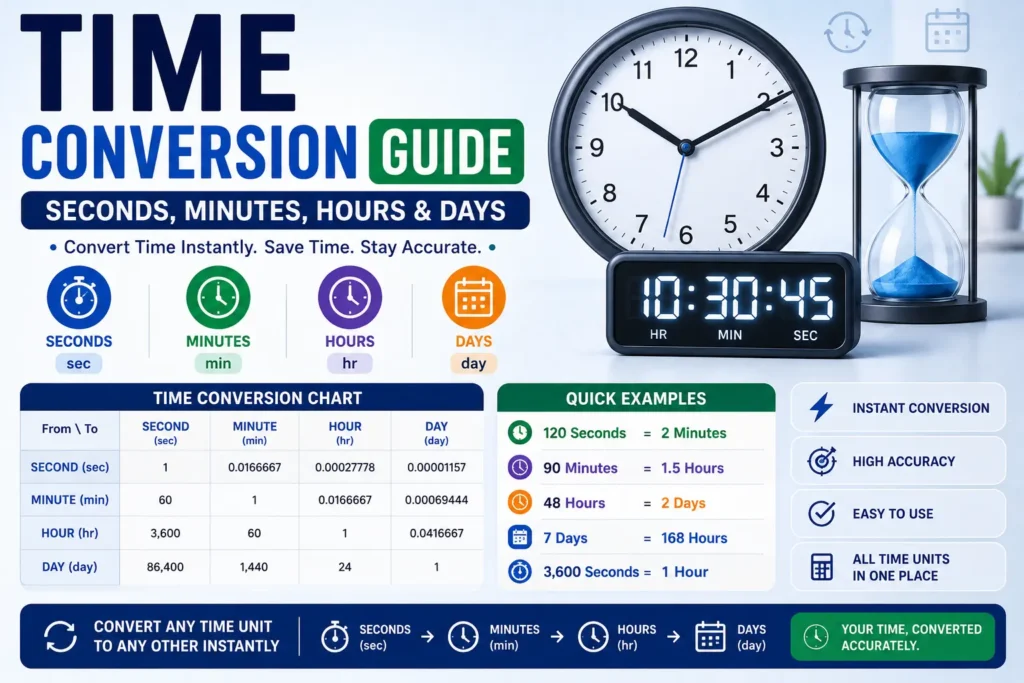
Time conversion turns a duration into another unit: seconds into minutes, hours into days, or a project estimate into weeks. Timers, timesheets, recipes, and workout logs all need a reliable time conversion chart when the number on the screen is not the unit you need to report. This guide covers core duration math, then points to separate blogs for clock formats, time zones, and pool-course times.
Convert time now: Open the free Time Converter, seconds through years in one dropdown. No sign-up required.
What time conversion covers (duration, not clock face)
Here, time conversion means rewriting a length of time: how long something lasts. Sixty seconds make a minute; sixty minutes make an hour; twenty-four hours make a day. That is different from reading a 24-hour clock, shifting a meeting across time zones, or comparing swim times between pool lengths, those topics have their own guides linked below.
Most duration factors are exact integers. The exceptions are calendar-ish units (months, years) where “average” lengths appear in converters, use those carefully for payroll or legal deadlines.
Plain-language time formulas
- Minutes ↔ seconds: multiply minutes by 60. Divide seconds by 60 for minutes.
- Hours ↔ minutes: multiply hours by 60. Divide minutes by 60 for hours.
- Hours ↔ seconds: multiply hours by 3,600.
- Days ↔ hours: multiply days by 24.
- Weeks ↔ days: multiply weeks by 7.
- Years ↔ days (common converter average): often 365.25 days per year for long-span estimates.
Time conversion chart
| Unit | Equals |
|---|---|
| 1 minute | 60 seconds |
| 1 hour | 60 minutes / 3,600 seconds |
| 1 day | 24 hours / 1,440 minutes |
| 1 week | 7 days / 168 hours |
| 1 year (avg.) | ≈ 365.25 days |
Quick duration table
| Input | Result |
|---|---|
| 90 seconds | 1.5 minutes |
| 150 minutes | 2.5 hours |
| 36 hours | 1.5 days |
| 10 days | ≈ 1.43 weeks |
| 2 weeks | 336 hours |
Worked examples
Example 1, podcast length for a schedule
An episode is 2,700 seconds long. In minutes: 2,700 ÷ 60 = 45 minutes. In hours: 45 ÷ 60 = 0.75 hours.
Example 2, timesheet overtime block
You logged 11.25 hours on a shift. In minutes: 11.25 × 60 = 675 minutes. Report the decimal hours your payroll system expects, or convert once and keep the same unit end-to-end.
Example 3, project buffer in days
A task estimate is 56 hours of focused work. In days at 8 hours/day: 56 ÷ 8 = 7 workdays (not 56 ÷ 24 calendar days).
Common time conversion mistakes
- Treating decimal hours as hours:minutes. 1.5 hours is 1 hour 30 minutes, not 1:50.
- Using 30 days for every month when a deadline is calendar-specific.
- Mixing stopwatch seconds with clock time-of-day without labeling the unit.
- Converting work hours with 24-hour days when the estimate assumed an 8-hour workday.
Related topics (bridge only)
These angles have dedicated blogs, use them when that is the real question:
- Military time explained, 24-hour clock reading and AM/PM conversion
- Time zone conversion guide, PST, EST, GMT/UTC offsets and meeting planning
- Swimming time conversions, SCY vs LCM course standards
Time converter tools
Use the Time Converter for any duration pair, or open a focused tool:
Related reading
- Military time explained, 24-hour clock reading and AM/PM conversion
- Time zone conversion guide, PST, EST, GMT/UTC offsets
- Swimming time conversions, SCY vs LCM course standards
- Unit conversion chart & calculator guide, full category map