
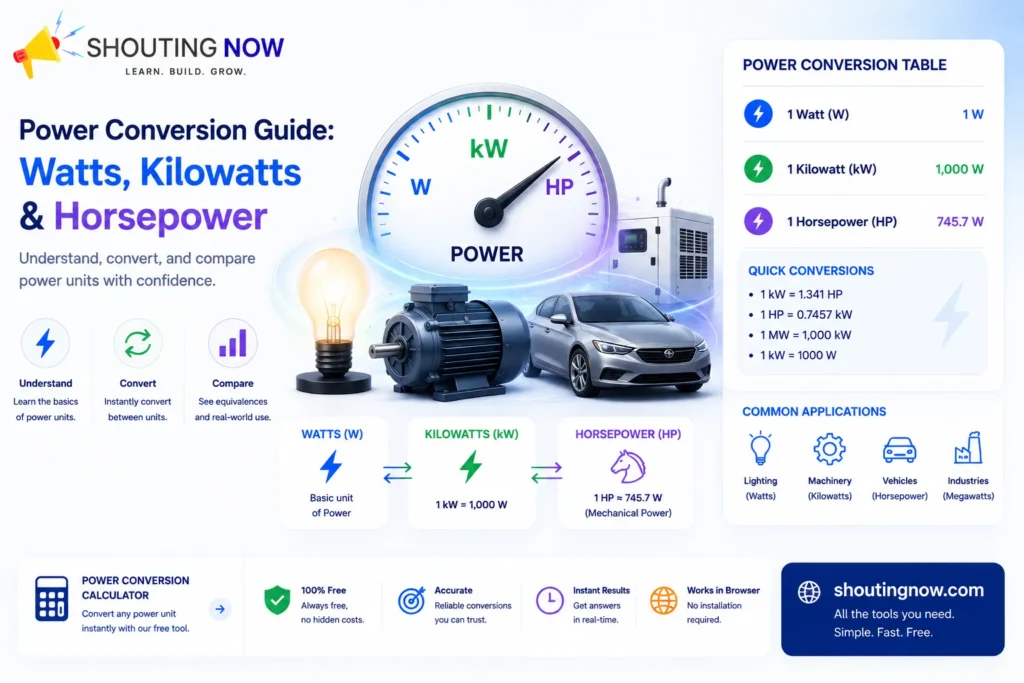
Power conversion is how you compare motors, heaters, and generators when one label shows watts and another shows horsepower or kilowatts. Power is energy per time, the rate at which work is done or electricity is delivered, so the same machine can be described in W, kW, or hp without changing its output. This guide is the category overview: formulas, a reference table (including hp↔kW), and tool links. For the full automotive and appliance walkthrough of horsepower and kilowatts, use the dedicated horsepower to kilowatts article.
Convert power now: Open the free Power Converter, watts, kilowatts, horsepower, and related units. No sign-up required.
What power conversion covers
Power measures how fast energy is used or produced. One watt equals one joule per second. Kilowatts suit household and industrial loads; horsepower remains common on engines and some motor nameplates. Converting power keeps those nameplates comparable when you size breakers, compare generators, or read mixed datasheets.
Energy (kWh, joules) is a total over time. If you need totals rather than rates, use the energy conversion guide instead.
Plain-language power formulas
- Watts ↔ kilowatts: divide W by 1,000 for kW. Multiply kW by 1,000 for W.
- Mechanical horsepower ↔ watts: 1 hp (mechanical) ≈ 745.7 W ≈ 0.7457 kW.
- Metric horsepower ↔ watts: 1 metric hp ≈ 735.5 W, slightly less than mechanical hp.
- Kilowatts ↔ mechanical horsepower: multiply kW by ≈ 1.341 for hp (or divide hp by 1.341 for kW).
Always match the horsepower convention on the nameplate (mechanical vs metric) before you trust a one-line factor.
Horsepower ↔ kilowatts reference table
Quick lookup for mechanical horsepower. For worked vehicle and appliance examples, see horsepower to kilowatts.
| hp (mech.) | kW (approx.) | W (approx.) |
|---|---|---|
| 0.5 | 0.373 | 373 |
| 1 | 0.746 | 746 |
| 5 | 3.728 | 3,728 |
| 10 | 7.457 | 7,457 |
| 50 | 37.285 | 37,285 |
| 100 | 74.570 | 74,570 |
Watts to kilowatts (everyday loads)
| W | kW |
|---|---|
| 100 | 0.10 |
| 500 | 0.50 |
| 1,500 | 1.50 |
| 3,000 | 3.00 |
| 7,500 | 7.50 |
Worked examples
Example 1, space heater nameplate
A heater is rated 1,500 W. In kilowatts: 1,500 ÷ 1,000 = 1.5 kW. That is the rate; overnight energy use still depends on hours run (kW × hours = kWh).
Example 2, small motor in horsepower
A pump motor is labeled 2 hp (mechanical). In kilowatts: 2 × 0.7457 ≈ 1.49 kW. Confirm whether the label means mechanical or metric hp before ordering a replacement.
Example 3, generator listing in kW
A portable generator advertises 3.5 kW continuous. In mechanical horsepower: 3.5 × 1.341 ≈ 4.69 hp. Use continuous rating for load planning, not peak surge.
Common power conversion mistakes
- Confusing kW with kWh. Kilowatts are power; kilowatt-hours are energy.
- Ignoring mechanical vs metric horsepower. The factors differ (~745.7 W vs ~735.5 W).
- Comparing peak and continuous ratings. Convert the same rating type on both machines.
Power converter tools
Use the multi-unit Power Converter for watts, kilowatts, horsepower, and related pairs:
Related reading
- Horsepower to kilowatts, deep dive for hp↔kW use cases and examples
- Engineering unit conversion reference, bridges force, power, and pressure
- Unit conversion chart & calculator guide, full category map