
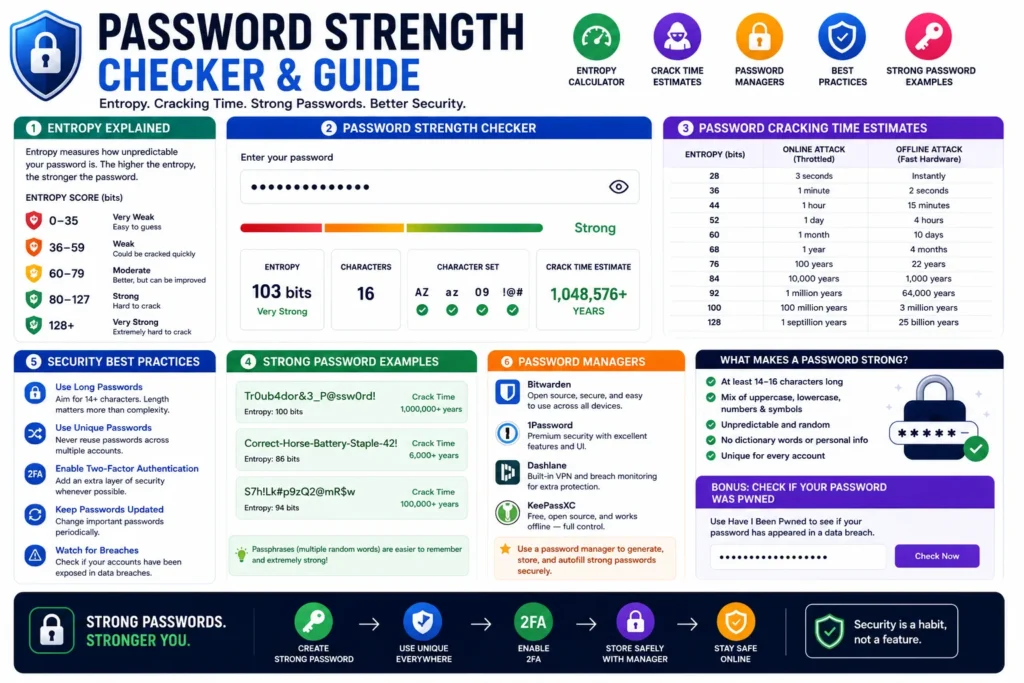
Most account breaches do not involve a clever hacker, they involve someone reusing “Password123” across five sites. This guide covers what a strength score actually tells you and the habits that matter more than any single clever password. Use the Password Strength Checker to test length and composition before you commit to a new one.
Try it free: Open the Password Strength Checker, runs entirely in your browser, no account or upload required.
What a strength score means
Treat the score as a rough estimate, not a guarantee. It measures how well a password resists common brute-force and dictionary-style attacks based on its length and character mix, not whether it has already leaked somewhere in a data breach.
Practical improvements
Aim for at least 12 characters rather than the bare minimum a site allows. Mix letter cases, numbers, and symbols instead of just adding a “1” at the end. Skip names, birthdays, and anything a stranger could guess from your social media. Most importantly, use a different password for every account, so one leaked site does not hand over the rest of your accounts too.
Writing tools resources on ShoutingNow
- Password Strength Checker, free online tool
- Password Strength Checker Guide: Entropy, Crack-Time, and Safer Password Habits, full walkthrough (this article)
- Real-Time Character Counter – No Limit
- AI Prompt Token Counter