
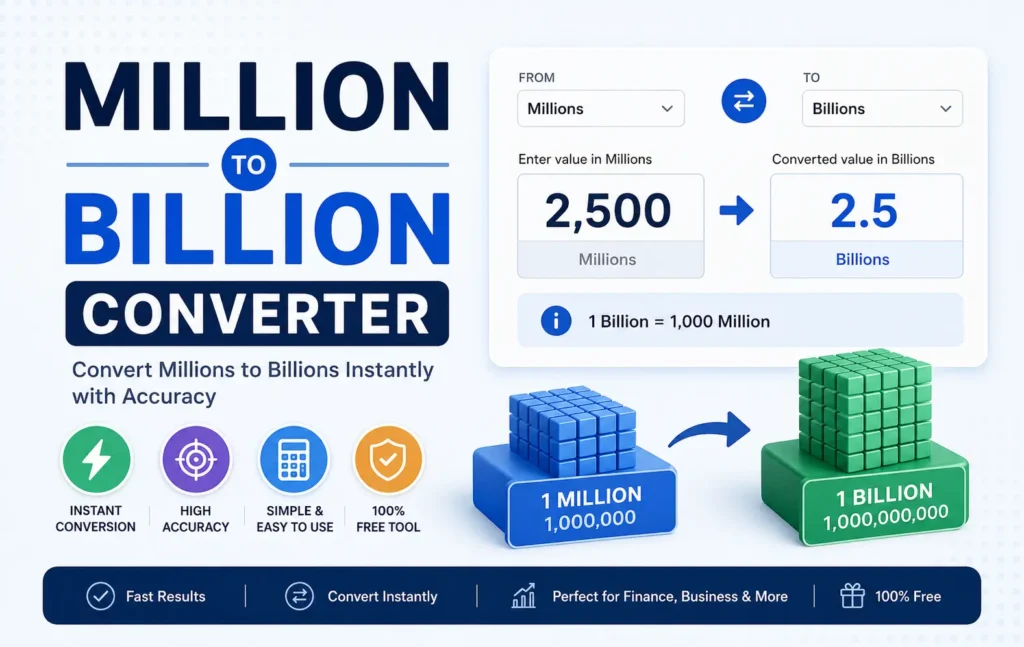
How to use this million to billion converter
- Pick a currency symbol for display ($, €, £, ₹, or ¥). This does not change the math.
- Choose Convert from: Million or Billion.
- Enter your number and click Calculate.
- Copy the result as full text, a B or M abbreviation, or scientific notation.
For example: 1,000 million becomes 1 billion. On a larger budget, 12,469,087,655 million works out to 12,469,087.655 billion.
How many million are in one billion?
Under the short scale, the one American English uses and the one UK official figures have followed since the 1970s, one billion equals one thousand million (1,000,000,000), or nine zeroes if you’re counting.
That works out to:
- 1 billion = 1,000 million
- 1 million = 0.001 billion
To put that in perspective: earning $100,000 a year, it would take 10 years to reach $1 million, and roughly 10,000 years at that same pace to hit $1 billion.
How to convert million to billion
Short-scale conversion (US / UK modern usage)
Just divide your million figure by 1,000. Five million dollars comes out to 0.005 billion, and one thousand million lands exactly on one billion.
How to convert billion to million
Reverse conversion
Multiply your billion figure by 1,000 instead. A $3.2 billion acquisition, for instance, comes out to $3,200 million.
How many zeros in 1 billion?
On the short scale, 1 billion equals 1,000,000,000, or nine zeros. The UK historically used a long-scale billion (one million million, twelve zeros), but government statistics have since switched to the thousand-million definition, lining up with the US and most international finance reporting.
Million to billion chart
| Million | Billion | Million | Billion |
|---|---|---|---|
| 1 million | 0.001 billion | 20 million | 0.02 billion |
| 2 million | 0.002 billion | 30 million | 0.03 billion |
| 5 million | 0.005 billion | 50 million | 0.05 billion |
| 10 million | 0.01 billion | 100 million | 0.1 billion |
| 100 million | 0.1 billion | 1,000 million | 1 billion |
Billion to million chart
| Billion | Million | Billion | Million |
|---|---|---|---|
| 1 billion | 1,000 million | 10 billion | 10,000 million |
| 2 billion | 2,000 million | 20 billion | 20,000 million |
| 5 billion | 5,000 million | 50 billion | 50,000 million |
What does a billion look like?
A billion dwarfs a million by a wide margin. One million seconds works out to about 12 days, while one billion seconds stretches to roughly 32 years. So when a headline cites multi-billion budgets or market caps, dividing by 1,000 turns that figure into millions, a scale most spreadsheets and mental math handle more comfortably.
Want more examples? The full Million to Billion Converter Guide has them.
Examples and use cases
Worked example
Take 2,500 million and convert it to billions on the short scale:
- 2,500 ÷ 1,000 gives you 2.5 billion
- Reverse it: 2.5 billion × 1,000 gets you back to 2,500 million
Real-world use cases
- Earnings headlines: a reporter turns “$45,000 million revenue” into $45 billion for readers who think in B-scale figures.
- Government budgets: a policy analyst normalizes line items quoted in millions into billions for cross-country comparisons.
- Startup valuations: a founder translates an $850 million acquisition offer into $0.85 billion when pitching to investors who think in B notation.
Related calculators
- Margin Calculator: gross, sales, and net profit margins
- ROI Calculator: return on investment as a percentage