
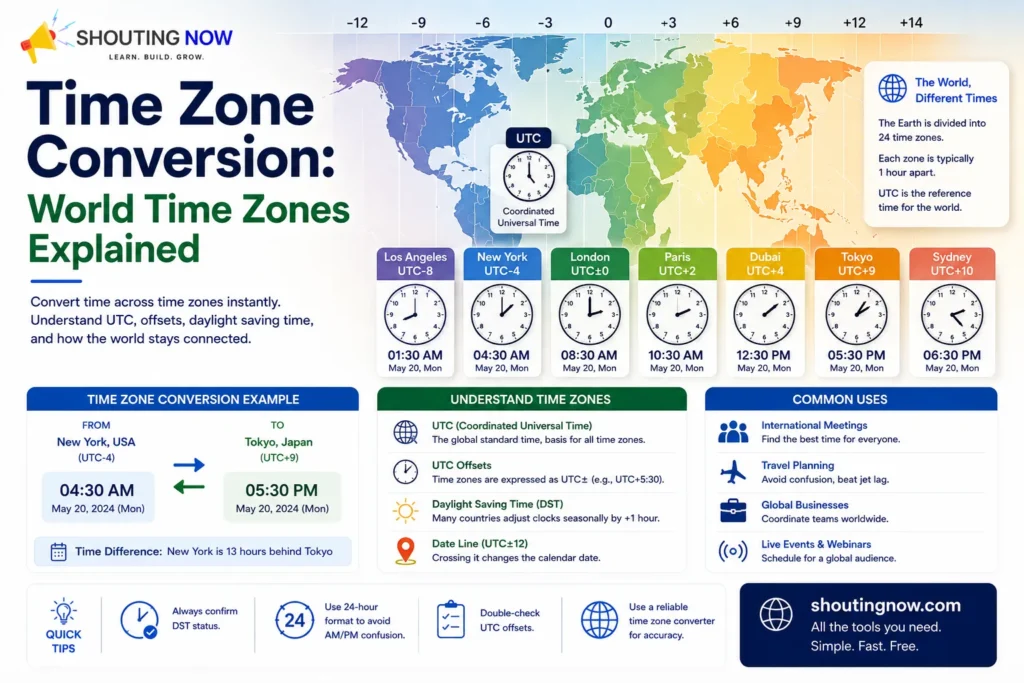
Try scheduling a call between three countries without checking a time zone converter first and you will end up with someone joining at 3 a.m. Working across borders is normal now, whether that means an online meeting, an international flight, a virtual class, or a family call overseas, and all of it depends on getting time zone conversion right.
This guide explains how world time zones work, how to convert time correctly, and common mistakes to avoid. This is not the same as converting 90 minutes into hours, duration lives on the time conversion guide. Clock-face 24-hour reading lives on military time explained. Here we own regional offsets and meeting math.
What is a time zone?
A time zone is a region that follows the same standard time. The Earth is divided into 24 primary time zones, roughly corresponding to 15 degrees of longitude. Most time zones are measured as an offset from Coordinated Universal Time (UTC).
- UTC+0, London (winter)
- UTC+1, Central Europe (winter)
- UTC+5:30, India
- UTC+8, China
- UTC+9, Japan
- UTC−5, Eastern US (standard time)
Why time zones exist
Because Earth rotates, different locations experience sunrise and sunset at different times. Time zones help keep local clocks aligned with daylight. Without them, neighboring countries could experience confusing differences in local time.
Understanding UTC
UTC (Coordinated Universal Time) is the international reference used for global timekeeping. Airlines, computer systems, weather services, satellites, and international organizations rely on UTC for consistency.
How time zone conversion works
- Find the source time zone.
- Find the destination time zone.
- Calculate the UTC difference.
- Add or subtract the required hours and minutes.
Example: New York at UTC−5 and India at UTC+5:30 differ by 10 hours 30 minutes in standard time.
Daylight saving time (DST)
Some countries move their clocks forward during part of the year. This is called Daylight Saving Time (DST). Not every country observes DST, so time differences may change during the year. Always check whether DST is active before scheduling international meetings.
Common time zone examples
| Location | Time Zone |
|---|---|
| London | UTC+0 / UTC+1 (DST) |
| New York | UTC−5 / UTC−4 (DST) |
| Los Angeles | UTC−8 / UTC−7 (DST) |
| India | UTC+5:30 |
| Dubai | UTC+4 |
| Singapore | UTC+8 |
| Tokyo | UTC+9 |
| Sydney | UTC+10 / UTC+11 (DST) |
Common conversion mistakes
Ignoring daylight saving time
DST changes the time difference for many countries.
Mixing AM and PM
Using a 24-hour clock reduces scheduling mistakes, see military time explained.
Forgetting half-hour offsets
Countries like India use a 30-minute offset rather than a whole hour.
Assuming every country uses one time zone
Large countries such as the United States, Canada, Australia, and Russia have multiple time zones.
Best practices
- Confirm both cities before converting.
- Check if DST is in effect.
- Use UTC for international events.
- Prefer the 24-hour clock for business communication.
- Verify meeting invitations before sending.
If you also need to rewrite a duration (call length, flight block), pair this article with the time conversion guide and the Time Converter.
One last note
Once you get comfortable with UTC offsets and remember to check daylight saving time, scheduling across time zones stops being a guessing game. Keep a converter handy for anything that matters, a flight, a meeting, a launch time, and you will stop double-checking your own math at midnight.
Related reading
- Time conversion guide, seconds, minutes, hours
- Military time explained, 24-hour clock conversion
- Swimming time conversions, pool-course standards
- Common unit conversion mistakes · History of measurement units · Metric vs imperial
- Unit conversion chart & calculator guide, cluster map