
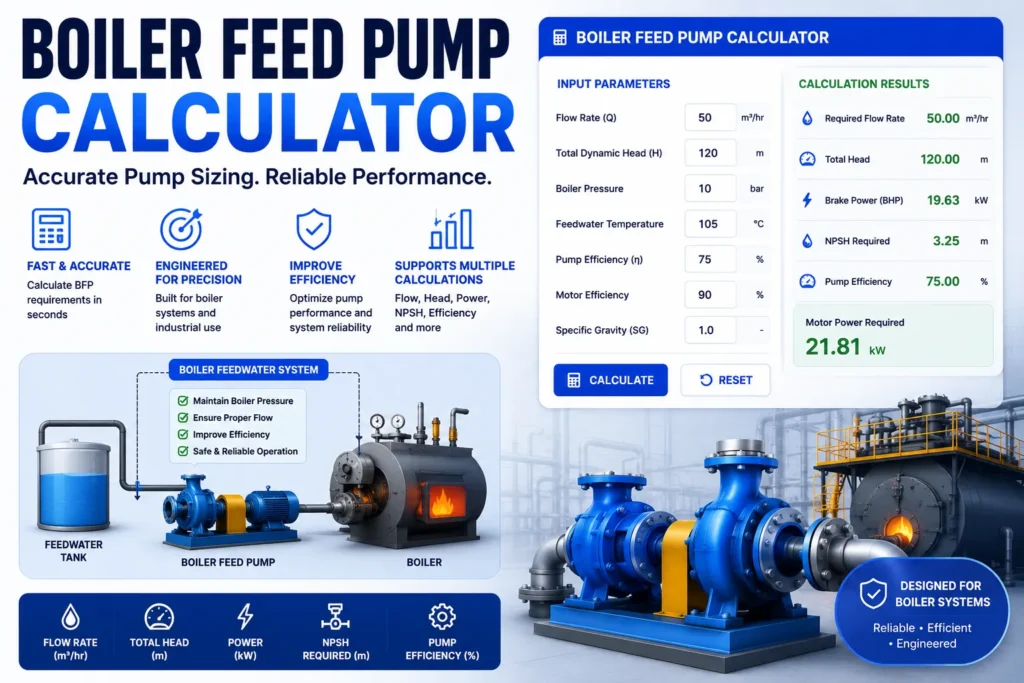
Boiler feed pumps (BFPs) deliver treated water to steam generators at the pressure and flow your boiler demands. Undersized pumps starve the boiler; oversized pumps waste energy and can run off the best-efficiency point. This guide walks through the same calculations our Boiler Feed Pump Calculator performs — total dynamic head, brake power, NPSH available, and line velocity — so you can interpret results with confidence and know when to escalate to a pump vendor.
Size your pump now: Open the free Boiler Feed Pump Calculator — TDH, brake power, NPSH available, velocity, and feedwater properties in a two-column layout. Save results locally in your browser.
Tutorial: using the boiler feed pump calculator
Basic operation
Enter operating parameters
- Flow rate — system delivery requirement in m³/hr; ~100 m³/hr is typical for medium industrial boilers.
- Suction & discharge pressures — from your P&ID; 1–2 bar suction and 10–50 bar discharge are common ranges.
- Temperature — deaerated feedwater, usually 80–120°C.
- Pipe diameter — actual line size for velocity checks (80–150 mm typical).
- Pump efficiency — manufacturer η at duty point (70–85% typical for multistage units).
- NPSH required — from the pump curve at design flow (2–5 m typical).
- Elevation difference — vertical lift between suction and discharge datums on your layout.
Interpret results
- Total dynamic head — should match the system requirement at design flow.
- Pump power — brake kW for motor sizing (add 10–15% margin).
- NPSH available — must exceed NPSH required by at least 0.5 m.
- Fluid velocity — aim for 1.5–3.0 m/s in feed lines.
- Fluid properties — verify density and viscosity match expected feedwater conditions.
Comprehensive guide to calculating boiler feed pump requirements
Steam generation in industrial plants depends on reliable feedwater delivery. Proper BFP sizing improves efficiency, reduces maintenance, and extends equipment life. The sections below mirror a field engineer’s workflow from duty definition through pump type selection and long-term operation.
Understanding boiler feed pump basics
A boiler feed pump raises feedwater from the deaerator or feed tank to boiler pressure. Centrifugal multistage pumps dominate continuous-duty plants because they handle high head at moderate flow with good efficiency. Positive-displacement designs appear where precise low-flow metering or intermittent duty is required.
Three parameters anchor every selection:
- Pump head — energy added per unit mass of water (metres TDH).
- NPSH — suction energy margin that prevents cavitation at the impeller eye.
- Minimum flow — manufacturer limit below which the pump overheats or vibrates.
Pump curves plot head, efficiency, and NPSHr against flow. Your operating point should sit near the best-efficiency region with adequate NPSH margin and above minimum flow at all expected load conditions.
Importance of proper pump sizing
Wrong sizing shows up as insufficient flow during peak steam demand, excessive power at part load, frequent seal leaks, or cavitation noise on the suction line. Matching discharge pressure, TDH, and NPSH to the real system — not a single catalog point — keeps the pump on its curve and inside mechanical seal design limits.
Consult manufacturer data for efficiency, NPSHr, and allowable operating envelope. Mechanical seals, warm-up lines, and minimum-flow recirculation are part of the system, not optional accessories on high-pressure BFPs.
Step-by-step sizing process
Step 1: determine the number of pumps
Assess peak steam output, condensate return, and blowdown losses to fix total feed flow. One pump often carries normal load; a second identical pump provides redundancy for maintenance or failure. Some plants run two pumps at 60% each for efficiency and reserve capacity.
- Evaluate boiler evaporation rate and turndown.
- Add margin for future capacity or fouled heat transfer.
- Decide between single, duty/standby, or parallel operation.
Step 2: modulating vs on-off control
Modulating control varies speed or impeller staging to track steam demand — best when load swings and precise drum level control matter. On-off control runs the pump at full speed or stops it — simpler and cheaper where steam load is steady. Variable-speed drives on multistage BFPs are increasingly common for energy savings.
Step 3: calculate discharge head
Discharge head includes static lift, friction losses in pipes/fittings, and pressure at the boiler economiser or drum connection. Friction depends on flow, pipe size, and length — use your isometric or hydraulic software for detailed loss, then compare to the TDH estimate from our calculator as a sanity check.
Step 4: assess net flow rates
Net feed flow equals steam generation plus blowdown minus condensate return that does not re-enter the feed train. Plot the system curve (head vs flow) and mark the intersection with the pump curve. Verify the pump can maintain minimum flow at the lowest expected steam load — often via a recirculation line to the deaerator.
Step 5: determine total pump capacity
Size for maximum foreseeable demand, not average day-to-day load. Cross-check TDH and power at that point using temperature-corrected water properties. If the duty sits far left of the BEP on the curve, consider a smaller stage group or speed reduction.
Step 6: incorporate boiler evaporation rate
Evaporation rate (kg/hr or t/hr of steam) drives base flow requirement. Tie pump hydraulic duty to boiler MCR (maximum continuous rating) and verify part-load performance at minimum steam output. Seasonal or batch processes may need two duty points evaluated on the same pump curve.
Overview of pump types
Centrifugal pumps use impeller rotation for high-flow, low-viscosity service — standard for boiler feedwater. Positive-displacement pumps trap fixed volumes per revolution; suited to dosing or very high pressure at low flow. Multistage centrifugal pumps stack impellers for the high heads boiler systems require without extreme single-stage speed.
Horizontal pump options
Horizontal barrel or between-bearings designs ease maintenance access to seals and bearings. Common in utility and process plants where floor space is available and suction conditions are stable.
Vertical pump options
Vertical canned or turbine-style pumps save floor space and suit tank-mounted suction with submerged barrel designs. Popular when deaerator storage is elevated and NPSHa must be carefully managed.
Technical considerations
Shaft seals
Mechanical seals are standard on modern BFPs; packing is legacy. Seal plans must handle feedwater temperature, pressure, and dissolved oxygen. Flush and cooling arrangements follow API or manufacturer standards — never assume a single seal fits all feedwater chemistries.
Casing and rotor construction
Cast or forged casings contain pressure; impellers and shafts transmit torque. Material choice (chrome steel, stainless) depends on temperature, oxygen content, and pH. Balanced rotors and alignment reduce vibration and bearing wear.
Pump affinity laws
For the same pump at constant impeller diameter:
- Flow ∝ speed
- Head ∝ speed²
- Power ∝ speed³
These relationships help estimate performance when trimming impellers or applying VFD speed control — always confirm with the manufacturer curve after changes.
Best practices
Safety margins
- Add 10–15% to calculated brake power for motor nameplate rating.
- Target NPSHa > NPSHr + 0.5 m (10% margin is better).
- Watch velocity warnings — high speed in small pipes erodes fittings.
Troubleshooting
- High velocity (>3 m/s): increase pipe diameter or reduce flow in that line segment.
- Low NPSH available: shorten suction piping, enlarge suction line, raise deaerator level, or lower fluid temperature.
- High power consumption: check for excessive discharge pressure setpoint or throttled discharge valve.
Optimization tips
- Balance pipe cost against velocity and friction loss.
- Remember hotter feedwater lowers NPSHa because vapor pressure rises.
- Efficiency at part load affects annual energy — plot multiple operating points.
Maintenance and operation
Routine inspection covers seal leakage, bearing temperature, vibration, and discharge pressure stability. Track pump curve drift over years — wear ring clearance increases internal leakage and shifts the effective curve. For on-off plants, exercise standby pumps on a schedule so they start reliably when needed.
Pump redundancy
Standby pumps should match hydraulic capability and control logic of the duty unit. Automatic changeover on failure or low drum level is common in critical steam plants. Align minimum-flow protection on both trains.
Common challenges
Accurate suction pressure measurement is difficult when flashing or air ingress occurs. Cavitation from inadequate NPSHa destroys impellers quickly. Minimum-flow bypass valves that stick open or closed create either energy waste or thermal trips — test them during outages.
Conclusion and key takeaways
Boiler feed pump calculation ties steam demand, system hydraulics, and pump curves into one duty point. Use structured estimates for TDH, power, and NPSH before you commit to a purchase specification.
- Match pump specifications to verified system requirements.
- Include temperature and elevation in every NPSH check.
- Apply motor and NPSH safety margins.
- Maintain minimum flow and monitor seals.
- Work with manufacturers on final curve selection and control strategy.
Ready to run the numbers? Open the Boiler Feed Pump Calculator and save your sizing summary for your next design review.
Boiler feed pump resources on ShoutingNow
- Boiler Feed Pump Calculator — TDH, power, NPSH, velocity, and fluid property estimates
- Boiler Feed Pump Calculator Guide — sizing workflow, pump types, and maintenance