
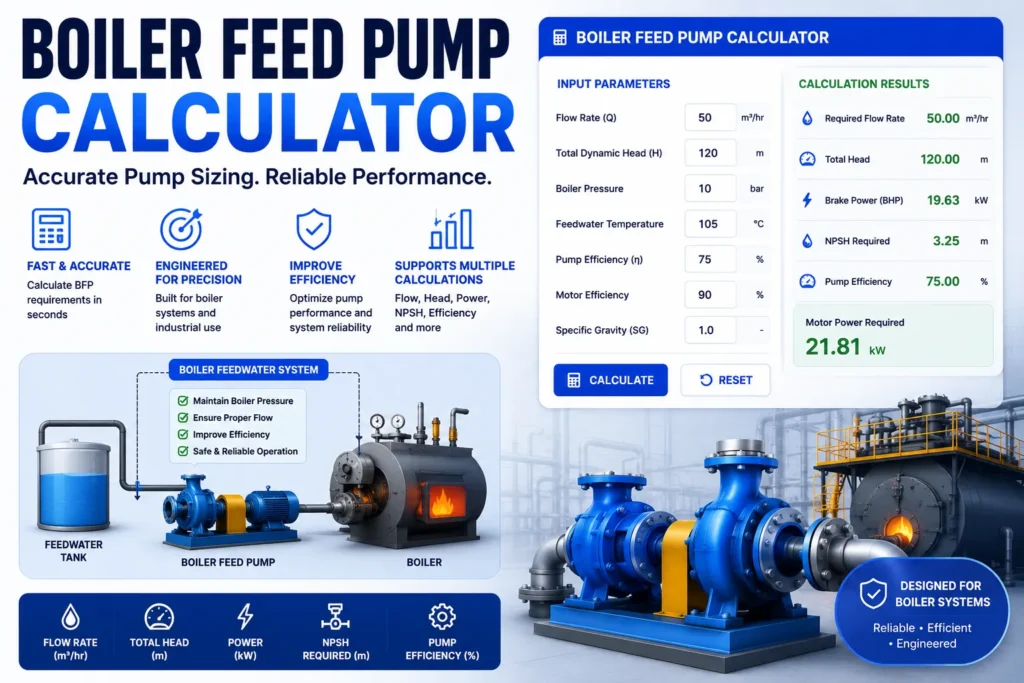
The Boiler Feed Pump Calculator estimates total dynamic head (TDH), brake power, net positive suction head available (NPSHa), pipe velocity, and feedwater density from your operating parameters. Use it during preliminary pump selection for steam plants, district heating, and process boilers — then validate final duty points against manufacturer pump curves and your piping isometrics.
New to BFP sizing? Read our Comprehensive Guide to Boiler Feed Pump Requirements for step-by-step selection, redundancy, and maintenance practices.
How to use this calculator
- Flow rate (m³/hr) — required feedwater delivery; medium industrial boilers often run 50–150 m³/hr depending on steam load.
- Suction & discharge pressure (bar) — absolute or gauge values consistent with your P&ID; discharge is typically well above suction (10–50 bar discharge is common).
- Temperature (°C) — deaerated feedwater temperature (often 80–120°C); affects vapor pressure, density, and NPSHa.
- Pipe diameter (mm) — suction or discharge line used for velocity check (80–150 mm typical).
- Pump efficiency (%) — manufacturer η at the expected duty point (70–85% for multistage BFPs).
- NPSH required (m) — from the pump data sheet at design flow (often 2–5 m).
- Elevation difference (m) — static lift between suction reference and pump centerline or discharge datum per your layout.
Click Calculate to update TDH, power, NPSHa, velocity, and fluid properties. Add 10–15% to brake power when selecting motor nameplate rating.
Key formulas
Pressure difference is converted to head using 10.2 m per bar for water near boiler feed conditions. Static elevation and velocity head are added for total dynamic head.
Q is m³/hr, ρ is kg/m³, H is TDH in metres, η is pump efficiency as a decimal, and P is brake power in kW.
NPSHa must exceed NPSHr by at least 0.5 m (10% margin is safer). Low NPSHa leads to cavitation and seal damage.
Interpreting results
| Output | What to check |
|---|---|
| Total Dynamic Head | Matches system curve at design flow; compare to pump curve head at the same Q. |
| Pump Power | Brake kW before motor losses; size motor with 10–15% margin. |
| NPSH Available | Must be > NPSH required; improve suction conditions if margin is thin. |
| Fluid Velocity | Keep 1.5–3.0 m/s in feed lines; high velocity increases friction and erosion. |
| Density & Viscosity | Confirm feedwater properties match deaerator outlet conditions. |
Best practices
- Maintain minimum flow through the pump at low load to avoid overheating and seal failure.
- Prefer modulating control when steam load varies; on-off control suits stable baseload plants.
- Plan at least one standby pump for critical steam generation.
- Monitor mechanical seals and bearing temperature during commissioning.
Related reading
- Boiler Feed Pump Calculator Guide: Sizing, TDH, NPSH & Power — tutorial, troubleshooting, and pump-type overview.