
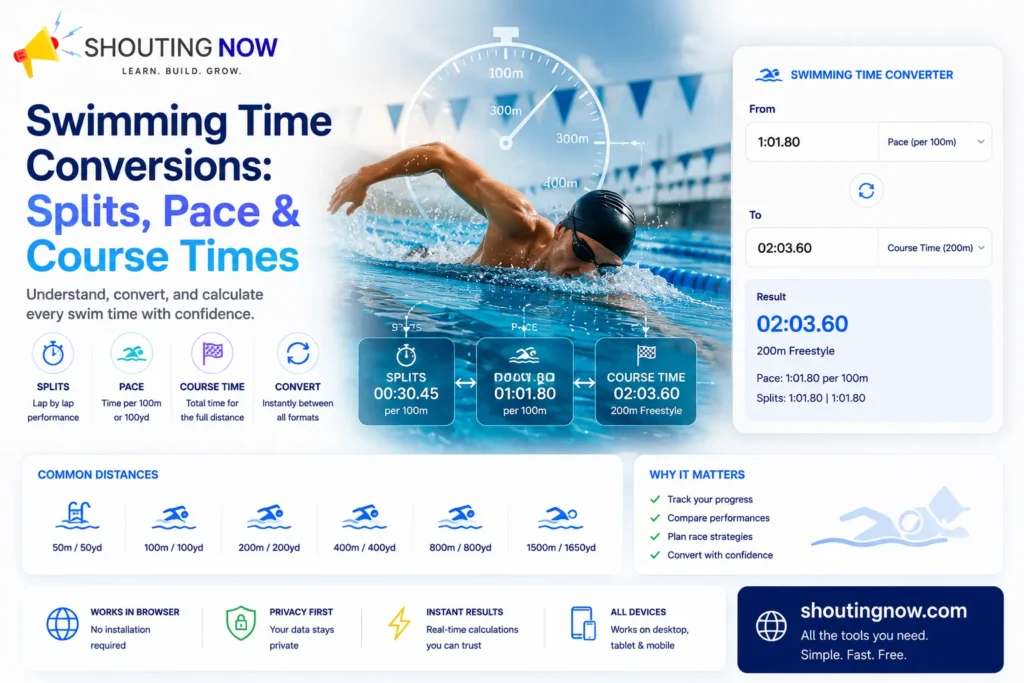
Swimming performance is measured in fractions of a second. Whether you are a beginner, competitive swimmer, coach, or parent, understanding swimming time conversions helps you compare performances across different pools, race distances, and training sessions.
This guide explains swimming time conversions, split times, race pace calculations, short course vs. long course pools, and common timing mistakes. This is not civil clock math. For seconds ↔ minutes, use the time conversion guide and the Time Converter. For 24-hour schedules or zone shifts, see military time and time zone conversion.
Why swimming time conversions matter
Swim times are used to compare race performances, track personal records (PRs), calculate training pace, estimate future race times, compare different pool lengths, and qualify for competitions. Accurate timing is essential because even a small improvement can change race results.
Understanding pool lengths
| Pool Type | Length |
|---|---|
| Short Course Yards (SCY) | 25 yards |
| Short Course Meters (SCM) | 25 meters |
| Long Course Meters (LCM) | 50 meters |
Because turns affect speed, the same swimmer may record different times in each pool.
What are split times?
Split times measure how long it takes to complete each section of a race. Example for a 200-meter freestyle:
- 50m Split
- 100m Split
- 150m Split
- 200m Finish
Analyzing splits helps swimmers improve pacing.
Race pace calculations
Pace is the average time required to swim a fixed distance. For example, 100 meters in 1:20 means an average pace of 40 seconds per 50 meters. Maintaining consistent pace is one of the keys to competitive swimming.
Converting swim times
Coaches often compare performances between SCY and SCM, SCM and LCM, and 50m and 25m pools. These conversions are estimates because turns, underwater kicks, and wall push-offs influence results. Specialized swimming conversion calculators provide the most accurate estimates — treat any factor as a planning tool, not official world-record math.
Common timing mistakes
Comparing different pool lengths
A faster time in a short course pool does not always mean a better performance because additional turns provide speed boosts.
Ignoring split times
Looking only at the final time hides pacing problems.
Poor manual timing
Hand timing is generally less accurate than electronic timing systems.
Rounding too early
Keep full precision until official results are calculated.
Tips to improve swim times
- Practice consistent pacing.
- Focus on efficient turns.
- Improve underwater technique.
- Track every workout.
- Compare times in the same pool length whenever possible.
Common uses for swimming time conversions
Swim meets, club competitions, Olympic qualification, college recruiting, fitness swimming, and triathlon training all rely on clear course labels next to every time (SCY, SCM, LCM).
Final thoughts
Swimming time conversions make it easier to compare performances across different competitions and pool formats. By understanding pool lengths, split times, pacing, and conversion methods, swimmers and coaches can make better training decisions and monitor long-term progress.
Related reading
- Time conversion guide — duration charts and formulas
- Military time explained — 24-hour clock reading
- Time zone conversion guide — PST/EST/UTC offsets
- Common unit conversion mistakes · Metric vs imperial
- Unit conversion chart & calculator guide — cluster map