
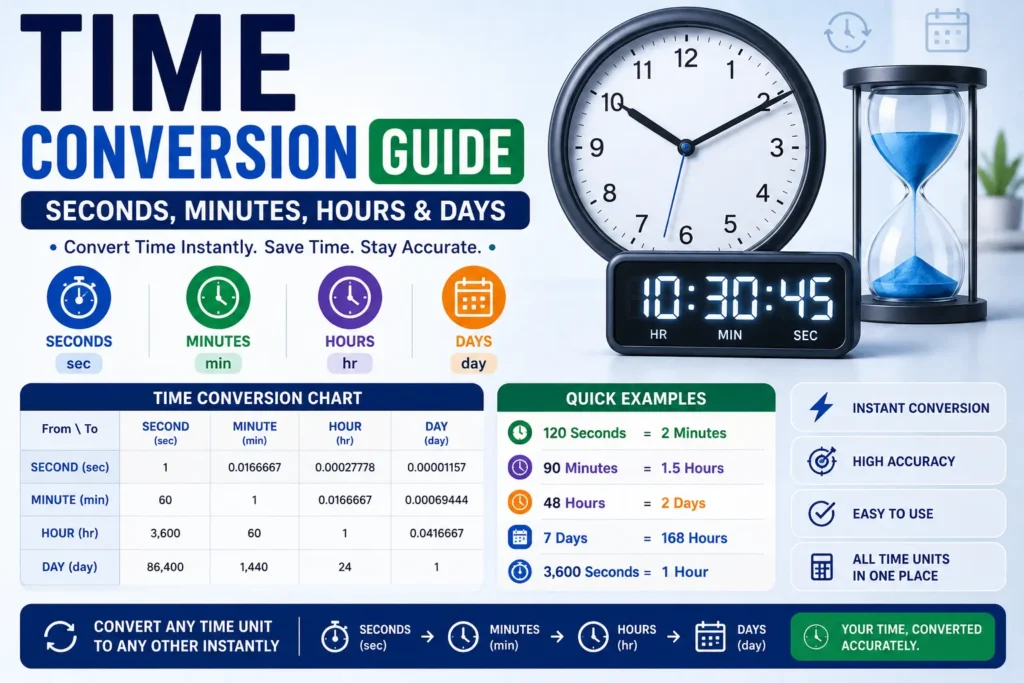
Time conversion turns a duration into another unit: seconds into minutes, hours into days, or a project estimate into weeks. Timers, timesheets, recipes, and workout logs all need a reliable time conversion chart when the number on the screen is not the unit you need to report. This guide covers core duration math — then points to separate blogs for clock formats, time zones, and pool-course times.
Convert time now: Open the free Time Converter — seconds through years in one dropdown. No sign-up required.
What time conversion covers (duration, not clock face)
Here, time conversion means rewriting a length of time: how long something lasts. Sixty seconds make a minute; sixty minutes make an hour; twenty-four hours make a day. That is different from reading a 24-hour clock, shifting a meeting across time zones, or comparing swim times between pool lengths — those topics have their own guides linked below.
Most duration factors are exact integers. The exceptions are calendar-ish units (months, years) where “average” lengths appear in converters — use those carefully for payroll or legal deadlines.
Plain-language time formulas
- Minutes ↔ seconds: multiply minutes by 60. Divide seconds by 60 for minutes.
- Hours ↔ minutes: multiply hours by 60. Divide minutes by 60 for hours.
- Hours ↔ seconds: multiply hours by 3,600.
- Days ↔ hours: multiply days by 24.
- Weeks ↔ days: multiply weeks by 7.
- Years ↔ days (common converter average): often 365.25 days per year for long-span estimates.
Time conversion chart
| Unit | Equals |
|---|---|
| 1 minute | 60 seconds |
| 1 hour | 60 minutes / 3,600 seconds |
| 1 day | 24 hours / 1,440 minutes |
| 1 week | 7 days / 168 hours |
| 1 year (avg.) | ≈ 365.25 days |
Quick duration table
| Input | Result |
|---|---|
| 90 seconds | 1.5 minutes |
| 150 minutes | 2.5 hours |
| 36 hours | 1.5 days |
| 10 days | ≈ 1.43 weeks |
| 2 weeks | 336 hours |
Worked examples
Example 1 — podcast length for a schedule
An episode is 2,700 seconds long. In minutes: 2,700 ÷ 60 = 45 minutes. In hours: 45 ÷ 60 = 0.75 hours.
Example 2 — timesheet overtime block
You logged 11.25 hours on a shift. In minutes: 11.25 × 60 = 675 minutes. Report the decimal hours your payroll system expects, or convert once and keep the same unit end-to-end.
Example 3 — project buffer in days
A task estimate is 56 hours of focused work. In days at 8 hours/day: 56 ÷ 8 = 7 workdays (not 56 ÷ 24 calendar days).
Common time conversion mistakes
- Treating decimal hours as hours:minutes. 1.5 hours is 1 hour 30 minutes — not 1:50.
- Using 30 days for every month when a deadline is calendar-specific.
- Mixing stopwatch seconds with clock time-of-day without labeling the unit.
- Converting work hours with 24-hour days when the estimate assumed an 8-hour workday.
Related topics (bridge only)
These angles have dedicated blogs — use them when that is the real question:
- Military time explained — 24-hour clock reading and AM/PM conversion
- Time zone conversion guide — PST, EST, GMT/UTC offsets and meeting planning
- Swimming time conversions — SCY vs LCM course standards
Time converter tools
Use the Time Converter for any duration pair, or open a focused tool:
Related reading
- Military time explained — 24-hour clock reading and AM/PM conversion
- Time zone conversion guide — PST, EST, GMT/UTC offsets
- Swimming time conversions — SCY vs LCM course standards
- Unit conversion chart & calculator guide — full category map