
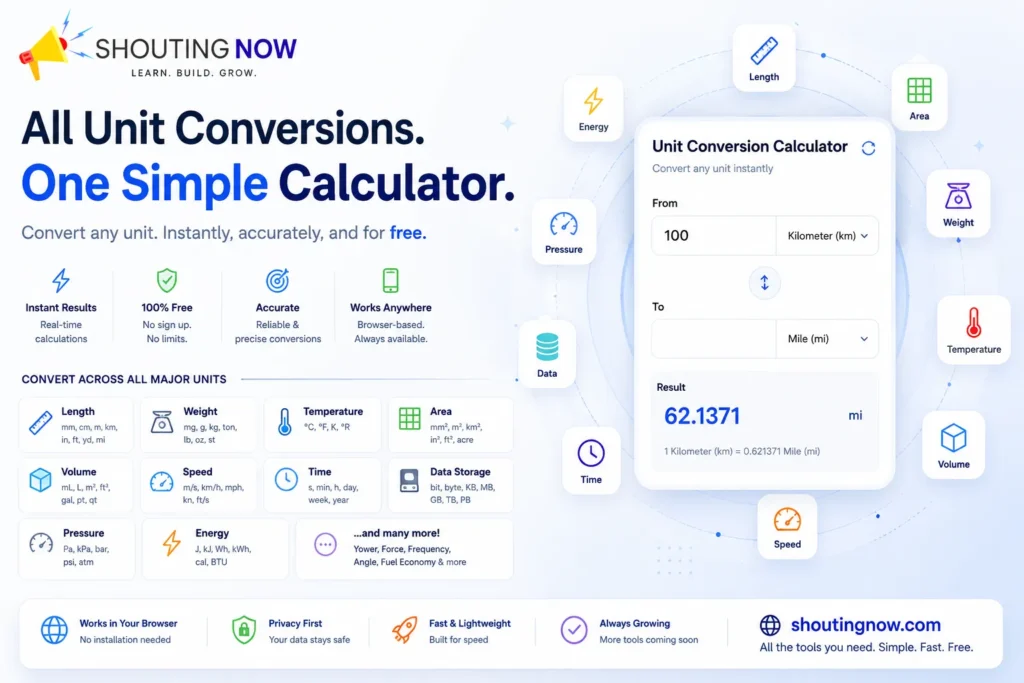
Unit conversion means writing the same measurement in a different unit — meters instead of feet, kilograms instead of pounds, or any other pair within one quantity type. This hub is the map for ShoutingNow’s unit conversion cluster: a short orientation, then every category guide in the same order as the guide steps in the sidebar.
Convert now: Open the free Conversion Calculator — pick a category, enter a value, and get instant results plus a full equivalence table. No sign-up required.
What unit conversion means
Most everyday conversions are linear: multiply or divide by a fixed ratio (1 inch = 2.54 cm exactly). A few quantities use offset scales — temperature is the classic case — so a calculator applies the right formula instead of a single multiplier. Deep formula tables, worked examples, and pair tools live on each child guide below. Use this page to pick the right category, then open that guide.
Everyday measurement guides
These six guides cover the units people meet in DIY, cooking, land, weather, and schedules. Open the guide that matches the quantity you are converting.
Length conversion
Meters, centimeters, inches, and feet for cut lists, openings, and product specs. The length conversion guide has plain formulas, tables, and converter links. For job-site habits, see construction measurement tips.
Weight conversion
Kilograms, pounds, ounces, and grams for recipes, shipping, and body weight. Start with the weight conversion guide when you need charts and free mass converters.
Area conversion
Square meters, square feet, acres, and hectares for floors, lots, and land ads. Use the area conversion guide for squared factors — and acre vs hectare when land listings mix systems.
Volume conversion
Liters, milliliters, US and imperial gallons, cups, and cubic measures for cooking, fuel, and tanks. The volume conversion guide keeps gallon types and cubic units clear.
Temperature conversion
Celsius, Fahrenheit, and Kelvin for weather, ovens, and lab notes. The temperature conversion guide covers the offset formulas; Celsius vs Fahrenheit explains when each scale shows up in daily life.
Time conversion
Seconds, minutes, hours, days, and weeks for timers, payroll, and pacing. Open the time conversion guide for charts, then branch to military time, time zone conversion, or swimming time conversions when the question is clocks, travel, or race pace — not unit arithmetic alone.
Science and engineering guides
These five guides cover pressure, energy, force, power, and speed — the units that show up in specs, labs, and machinery. For a cross-category cheat sheet, see the engineering unit conversion reference.
Pressure conversion
PSI, bar, kilopascals, atmospheres, and mmHg for tires, HVAC, and gauges. The pressure conversion guide holds the formulas; understanding pressure units explains when each label appears on equipment.
Energy conversion
Joules, calories, kilocalories, BTU, and watt-hours for food labels, heating, and electricity. Use the energy conversion guide for tables and tool links — keep food “calories” distinct from physics joules.
Force conversion
Newtons, pound-force, and kilogram-force for loads and fasteners. The force conversion guide stays lean; newton vs pound-force digs into the naming confusion with mass units.
Power conversion
Watts, kilowatts, and horsepower for motors, appliances, and generators. Start with the power conversion guide; the dedicated horsepower to kilowatts article owns the hp↔kW deep dive.
Velocity conversion
Miles per hour, kilometers per hour, knots, and meters per second for road, air, and science contexts. The velocity conversion guide covers speed pairs and free converters.
Digital data and fuel guides
Three guides for storage size, network speed, and vehicle economy — niches that mix bit/byte language or US vs metric fuel labels.
Data storage conversion
Bytes, KB, MB, GB, and TB with decimal versus binary notes for drives and downloads. Open the data storage conversion guide when marketing “GB” and OS “GiB” disagree.
Data transfer rate conversion
Mbps, MB/s, Gbps, and related rates for internet plans and file transfers. The data transfer rate guide keeps bits-per-second distinct from bytes-per-second.
Fuel consumption conversion
MPG (US and UK), L/100 km, and km/L for car ads and trip planning. Use the fuel consumption guide when comparing economy figures across regions.
SI units and metric vs imperial
The International System of Units (SI) is the modern metric framework used in science, medicine, and most countries’ packaging and road signs. Base ideas you will see everywhere: meter (length), kilogram (mass), second (time), with derived units for area, volume, energy, force, and more. Prefixes (milli-, kilo-, mega-) scale by powers of ten.
Official definitions live with standards bodies such as NIST’s SI units overview and the BIPM measurement units pages. Daily life still mixes systems: the United States leans on customary units; the UK mixes metric with miles and imperial pints. For when each system shows up in travel, recipes, and real estate, read metric vs imperial. For how today’s units evolved, see the history of measurement units.
How to use the unit conversion calculator
- Open the Conversion Calculator.
- Choose the category tab that matches your quantity (length, weight, and so on).
- Enter a value, select From and To units, and read the result.
- Use the equivalence table to compare every unit in that category at once.
- Swap units when you need the reverse conversion.
For pair-specific tools (for example meters to feet), open the matching category guide above — each page lists its converters.
Avoiding common conversion traps
US vs imperial gallons, applying length factors to area, rounding too early, and treating temperature as a simple multiply are the mistakes that show up most often. Keep this hub as a map; use the checklist on common unit conversion mistakes when you want examples. For medical doses, aviation fuel, structural loads, or legal surveys, verify against official tables — educational converters are not a substitute for certified specs.
Need a number now? Use the free unit conversion calculator. Need formulas and tables for one unit type? Jump to the matching category guide in the sections above.
Related reading and tools
- Conversion Calculator — free multi-category unit converter with equivalence tables
- Metric vs imperial — when each system shows up in daily life
- History of measurement units — how trade marks became SI
- Common unit conversion mistakes — traps in recipes, shipping, and homework
- Celsius vs Fahrenheit · Engineering unit conversion reference
- Percentage Calculator · BMI Calculator
Formulas and pair converters for each unit type live in the category guides above.