
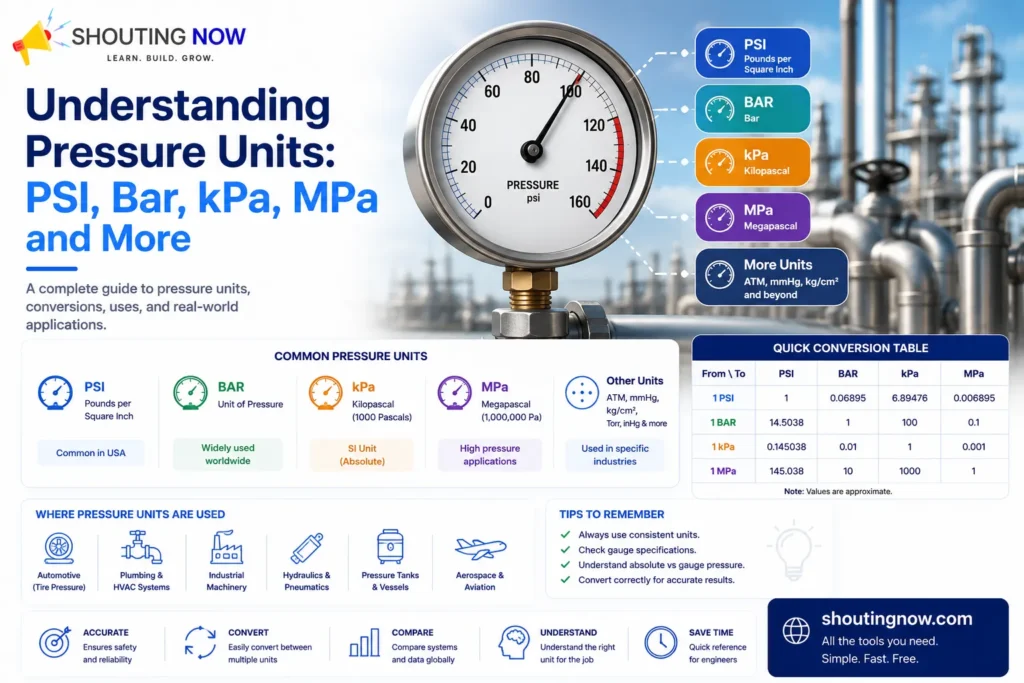
Pressure is measured in many industries, from checking a car’s tire pressure to operating hydraulic equipment and designing industrial systems. Different countries and industries use different pressure units, which is why understanding those labels matters before you convert.
Formulas and conversion tables live on the pressure conversion guide. This article is the field guide: where each unit appears, what “atmosphere” is doing in a lab, and how to read mixed gauges without treating every dial as interchangeable.
What is pressure?
Pressure is the amount of force applied over a specific area. It is commonly measured in PSI (pounds per square inch), bar, kilopascal (kPa), megapascal (MPa), pascal (Pa), and atmosphere (atm). Each unit measures the same physical quantity using different scales.
Common pressure units
PSI
PSI is widely used in the United States for tire pressure, air compressors, plumbing, and HVAC systems.
Bar
Bar is commonly used in Europe and many industrial applications. One bar is close to normal atmospheric pressure.
Pascal (Pa)
The pascal is the SI unit of pressure. Because one pascal is very small, engineers often use kilopascals (kPa) or megapascals (MPa).
kPa
Kilopascals are commonly used for weather reports, tire pressure, building systems, and engineering.
MPa
Megapascals are used for concrete strength, hydraulic systems, industrial machinery, and material testing.
Atmosphere (atm)
Atmospheres are often used in chemistry, physics, and scuba diving.
Pressure unit comparison
| Unit | Typical use |
|---|---|
| PSI | Tires, compressors |
| Bar | Automotive, industry |
| kPa | Engineering, weather |
| MPa | Heavy industry |
| Pa | Scientific calculations |
| atm | Laboratory and chemistry |
Common pressure conversions
| Unit | Approximate equivalent |
|---|---|
| 1 PSI | 6.895 kPa |
| 1 Bar | 100 kPa |
| 1 MPa | 1000 kPa |
| 1 atm | 101.325 kPa |
Convert live pairs with the Pressure Converter, then open the pressure conversion guide for full tables.
Where pressure units are used
Automotive
Vehicle tire pressure may be displayed in PSI, bar, or kPa depending on the manufacturer.
Manufacturing
Factories use pressure measurements for hydraulic and pneumatic systems.
Construction
Concrete strength and testing often reference MPa.
Healthcare
Medical equipment monitors pressure in different units depending on the application.
Common conversion mistakes
- Confusing PSI and bar — a value in PSI is much smaller than the same value expressed in bar.
- Mixing gauge and absolute pressure — some instruments measure gauge pressure, while others measure absolute pressure.
- Using the wrong unit — always verify which pressure unit appears in equipment manuals.
- Rounding too early — maintain precision until calculations are complete.
Tips for accurate pressure measurements
- Use calibrated gauges.
- Verify the measurement unit.
- Follow manufacturer recommendations.
- Use reliable pressure conversion calculators.
- Check temperature effects in industrial systems.
Final thoughts
Understanding pressure units makes it easier to maintain vehicles, operate industrial equipment, read engineering specifications, and perform scientific calculations. Whether you are working with PSI, bar, kPa, MPa, or atmospheres, knowing the correct unit and conversion factor helps prevent costly mistakes.
Related reading
- Pressure conversion guide — PSI, bar, kPa, atm, mmHg formulas and tables
- Engineering unit conversion reference — force, power, pressure bridge
- Horsepower to kilowatts · Metric vs imperial · Common unit conversion mistakes
- Unit conversion chart & calculator guide — cluster map