
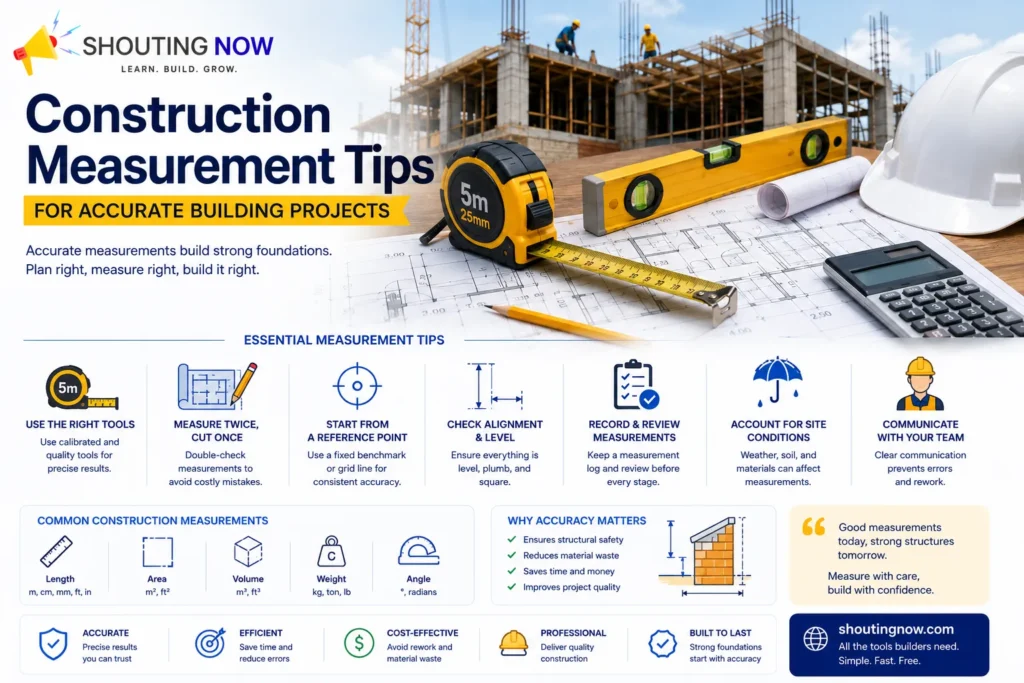
Accurate measurements are the foundation of every successful construction project. Whether you are building a house, installing cabinets, framing a wall, or completing a DIY project, precise measurements reduce waste, improve safety, and help materials fit correctly.
This guide covers essential construction measurement tips, common tools, and mistakes to avoid. Category formulas and charts live on the length conversion guide. For land parcels, see acre vs hectare and the area conversion guide.
Why accurate measurements matter
Poor measurements can lead to wasted materials, costly rework, misaligned walls, poor-fitting doors and windows, structural issues, and project delays. Measuring carefully before cutting or installing materials saves both time and money.
Essential measuring tools
Tape measure
A tape measure is the most common construction measuring tool. Use it for room dimensions, lumber lengths, door openings, window sizes, and cabinet installation. Always lock the tape before recording a measurement.
Framing square
A framing square helps create accurate 90-degree angles for wall framing, roof layout, stair construction, and checking square corners.
Spirit level
A level ensures horizontal and vertical alignment.
Laser distance meter
Laser measuring tools quickly measure longer distances with excellent accuracy.
Best construction measurement tips
- Measure twice, cut once — always verify measurements before making a cut.
- Use the same unit — avoid mixing inches, feet, centimeters, and millimeters in the same project.
- Record measurements immediately — write dimensions down to avoid relying on memory.
- Check for square — measure both diagonals of a rectangle; equal diagonals usually indicate the layout is square.
- Measure from consistent reference points — always use the same starting edge or benchmark.
Understanding construction units
Construction commonly uses inches, feet, millimeters, centimeters, and meters. Large civil engineering projects often use metric measurements, while residential work may use imperial units depending on the country. Dedicated pair tools like centimeters to inches and feet to meters beat phone-calculator improvisation. The multi-unit Length Converter handles the linear step.
Common measurement mistakes
- Reading the wrong tape mark
- Mixing metric and imperial units
- Forgetting material thickness
- Measuring from damaged tape hooks
- Rounding dimensions too early
- Recording incorrect values
See also common unit conversion mistakes for cross-cluster traps.
Tips for better accuracy
- Keep your tape straight.
- Use sharp pencils for marking.
- Verify dimensions before ordering materials.
- Check measurements after installation.
- Calibrate laser tools when required.
Where accurate measurements matter
House framing, flooring, roofing, concrete work, kitchen cabinets, furniture installation, plumbing, and electrical layouts all depend on consistent units and careful recording.
Final thoughts
Accurate construction measurements improve quality, reduce waste, and help projects finish on time. By using the right tools, following good measuring habits, and double-checking dimensions before cutting materials, you can avoid costly mistakes and achieve professional results.
Related reading
- Length conversion guide — formulas, tables, length tools
- Acre vs hectare — land-measurement context
- Metric vs imperial — systems coexistence
- Engineering unit conversion reference — cross-topic cheat sheet
- Common unit conversion mistakes — failure modes to avoid
- Unit conversion chart & calculator guide — cluster map