
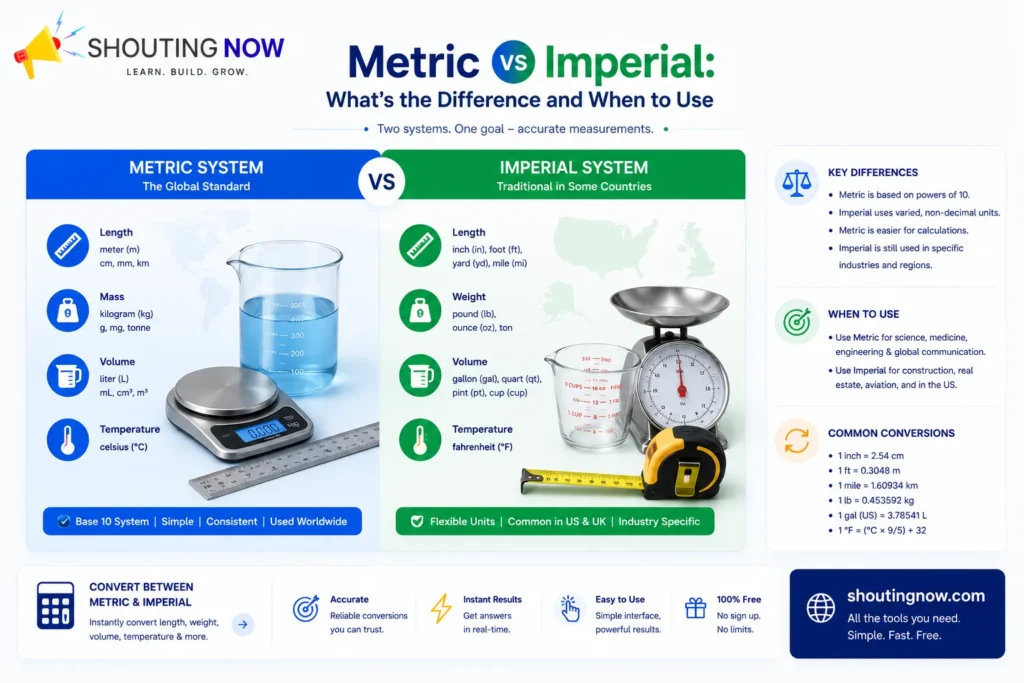
If you have ever converted inches to centimeters, miles to kilometers, or pounds to kilograms, you have used a unit conversion. The two most common measurement systems worldwide are the metric system and the imperial system (often called the US customary system in the United States).
Understanding the difference helps in travel, education, engineering, construction, science, shopping, cooking, and international business. The unit conversion chart & calculator guide maps every category on ShoutingNow. This article explains how both systems work, where they are used, practical conversion tips, and common mistakes to avoid. For the longer origin story, see the history of measurement units.
What is the metric system?
The metric system is the international standard for measurement (SI units). It is based on powers of 10, making calculations simple.
| Measurement | Units |
|---|---|
| Length | millimeter (mm), centimeter (cm), meter (m), kilometer (km) |
| Weight | gram (g), kilogram (kg), tonne |
| Volume | milliliter (mL), liter (L) |
| Temperature | Celsius (°C) |
Because every unit scales by 10, converting between units is straightforward.
What is the imperial system?
The imperial system originated in Britain, while the United States mainly uses US customary units, which are very similar but not identical for some volume measurements.
| Measurement | Units |
|---|---|
| Length | inch, foot, yard, mile |
| Weight | ounce, pound, ton |
| Volume | teaspoon, tablespoon, cup, pint, quart, gallon |
| Temperature | Fahrenheit |
Metric vs imperial at a glance
| Category | Metric | Imperial |
|---|---|---|
| Ease of conversion | Excellent | Moderate |
| Scientific use | Yes | Rare |
| Global adoption | Almost worldwide | Limited |
| Everyday use | Most countries | Mainly US |
Common unit comparisons
| Metric | Imperial |
|---|---|
| 1 inch | 2.54 cm |
| 1 foot | 30.48 cm |
| 1 mile | 1.609 km |
| 1 kilogram | 2.2046 pounds |
| 1 liter | 0.264 gallon (US) |
These conversions are among the most searched measurement conversions online. Run live pairs in the free Conversion Calculator or the Length Converter.
Why different countries use different systems
Nearly every country uses the metric system because it simplifies trade, science, medicine, and education. The United States still widely uses customary units in daily life, although science and medicine frequently use metric measurements.
Practical conversion tips
- Use a reliable conversion calculator for accuracy.
- Double-check the unit before converting.
- Do not confuse US gallons with imperial gallons.
- Keep engineering and construction drawings in one measurement system whenever possible.
- Round only at the final step.
Common conversion mistakes
Mixing units
Combining meters with feet or kilograms with pounds often causes calculation errors. The checklist in common unit conversion mistakes covers cross-cluster traps.
Wrong temperature formula
Converting Celsius and Fahrenheit requires formulas rather than multiplication — see Celsius vs Fahrenheit.
Confusing weight and mass
In science, kilograms measure mass while pounds often refer to weight in everyday language.
Using incorrect volume standards
US cups and UK cups are not identical.
Which industries use each system?
Engineering, manufacturing, construction, healthcare, aviation, automotive, international trade, and scientific research convert measurements every day. Many teams rely on specialized unit conversion tools when drawings and nameplates mix systems.
Best practices
- Use SI units whenever possible.
- Label every measurement clearly.
- Verify conversion factors.
- Use trusted conversion calculators.
- Keep precision until the final result.
Final thoughts
Both systems remain important. The metric system dominates globally because it is simple and standardized, while imperial units remain common in the United States and a few specialized applications. Learning how to convert between them helps avoid mistakes and makes everyday tasks, travel, education, and professional work much easier.
Related reading
- Unit conversion chart & calculator guide — hub map of all category guides
- History of measurement units — how trade marks became SI
- Celsius vs Fahrenheit — temperature scale companion
- Acre vs hectare — land measurement units
- Construction measurement tips — jobsite measuring habits
- Engineering unit conversion reference — cross-topic cheat sheet