
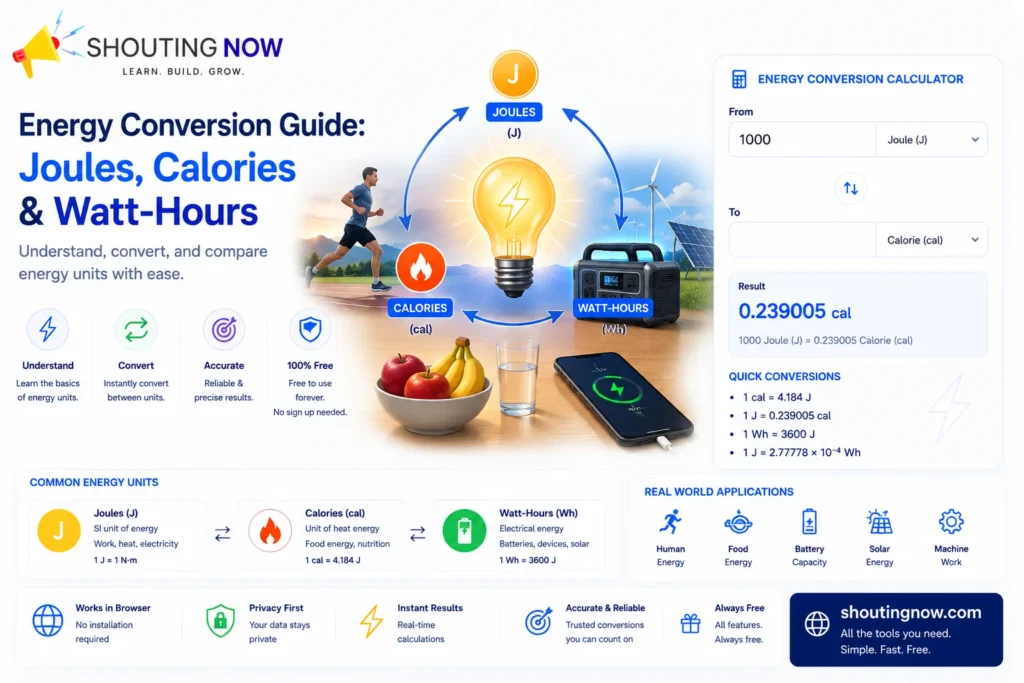
Energy conversion shows up when a nutrition label lists kilocalories, a lab notebook uses joules, or a utility bill is written in kilowatt-hours. Those units all describe the same physical idea — how much work or heat is stored or transferred — but they grew from different fields. This guide explains everyday energy conversion with plain formulas, tables, and worked examples, then links the free Energy Converter.
Convert energy now: Open the free Energy Converter — joules, calories, kilocalories, BTU, kilowatt-hours, and more. No sign-up required.
What energy conversion is (and when you need it)
Energy is the capacity to do work or transfer heat. Converting energy rewrites that quantity in another unit — joules to kilocalories, BTU to kilowatt-hours — without changing the physical amount. Food science, HVAC, and physics homework all use different “house units,” so conversion is how you compare a snack label to a SI calculation or a furnace rating to a utility meter.
Power (watts) is energy per time; this page stays on energy totals. For rates of energy use, see the power conversion guide after you finish here.
Plain-language energy formulas
- Calories (thermochemical) ↔ joules: 1 cal ≈ 4.184 J. Multiply cal by 4.184 for joules.
- Food Calories (kcal) ↔ joules: 1 kcal ≈ 4,184 J (same as 1 kilocalorie). Nutrition “Calories” with a capital C are usually kilocalories.
- Kilojoules ↔ kilocalories: divide kJ by ≈ 4.184 for kcal.
- BTU ↔ joules: 1 BTU ≈ 1,055.06 J.
- Kilowatt-hours ↔ joules: 1 kWh = 3,600,000 J exactly (3.6 MJ).
When a label says “Calories,” assume kilocalories unless the context is clearly chemistry-scale calories.
Energy conversion tables
Kilocalories to kilojoules (nutrition)
| kcal | kJ (approx.) |
|---|---|
| 50 | 209 |
| 100 | 418 |
| 250 | 1,046 |
| 500 | 2,092 |
| 2,000 | 8,368 |
Kilowatt-hours to megajoules (utility)
| kWh | MJ |
|---|---|
| 0.5 | 1.8 |
| 1 | 3.6 |
| 5 | 18 |
| 10 | 36 |
| 100 | 360 |
Worked examples
Example 1 — snack label to SI
A bar lists 220 kcal. In kilojoules: 220 × 4.184 ≈ 920 kJ. In joules that is about 9.20×10⁵ J — useful when a homework set insists on SI.
Example 2 — small appliance energy use
A device draws energy totaling 0.35 kWh over a day. In megajoules: 0.35 × 3.6 = 1.26 MJ. Compare that to a battery pack rated in Wh by converting Wh ÷ 1,000 = kWh first.
Example 3 — HVAC BTU to joules
A heater output of 12,000 BTU (as an energy quantity for a given period) is 12,000 × 1,055.06 ≈ 1.266×10⁷ J ≈ 12.66 MJ. Keep the time window explicit when you later turn this into power.
Common energy conversion mistakes
- Mixing food Calories with small calories. A capital-C Calorie on a label is usually 1 kcal = 1,000 cal.
- Confusing energy with power. Joules and kWh are energy; watts are power (energy per second).
- Forgetting kWh = 3.6 MJ. Utility math is exact; do not approximate as “about 3” for billing checks.
- Using the wrong BTU definition in precision work. International Table and thermochemical BTU differ slightly — match your standard.
Energy converter tools
Use the multi-unit Energy Converter for any pair on this page:
Related reading
- Unit conversion chart & calculator guide — full category map, including power when you need rates