
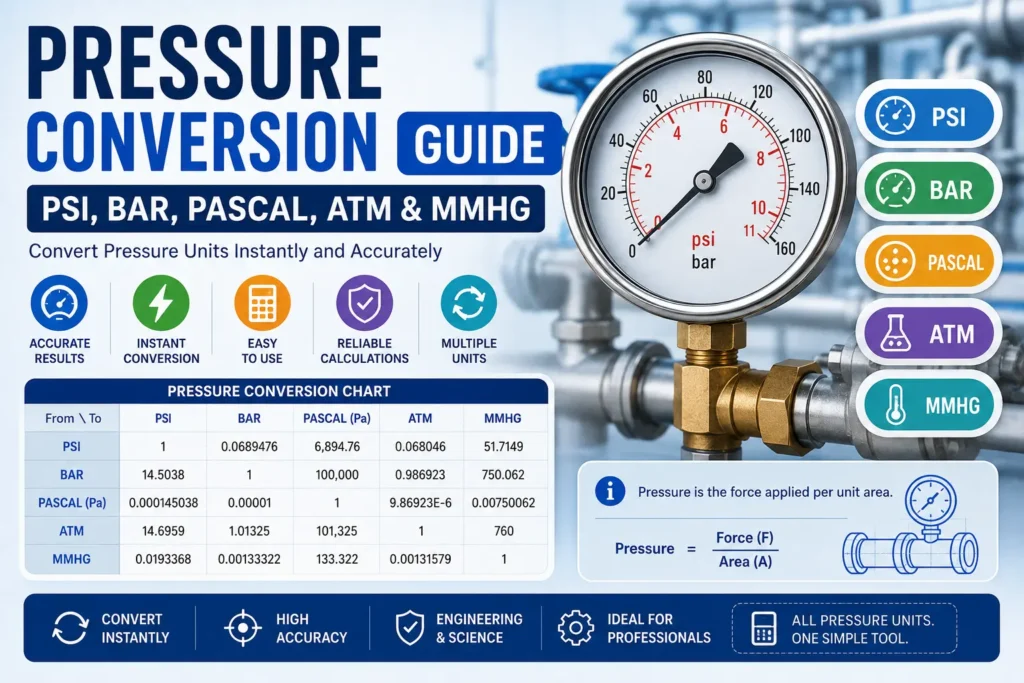
Pressure conversion shows up on tire sidewalls, compressor gauges, weather maps, and lab vacuum lines. PSI, bar, kilopascals, pascals, atmospheres, and mmHg all measure force per area — but labels rarely agree on one unit. This guide covers pressure conversion formulas and tables for the pairs people actually need, then links ShoutingNow’s pressure tools.
Convert pressure now: Open the free Pressure Converter — PSI, bar, kPa, Pa, atm, mmHg, and more. No sign-up required.
What pressure conversion is (and why gauges disagree)
Pressure is force spread over an area. Converting pressure rewrites the same reading in another unit: tire PSI to bar, weather millibars to kilopascals, or blood-pressure mmHg to another scale for a report. The SI base unit is the pascal (Pa); kilopascals and megapascals are everyday SI multiples. PSI remains common in the US; bar is common on European gauges; mmHg appears in medicine and older vacuum work; atm is a convenient atmospheric reference.
For how those units show up on tires, industrial gauges, and science contexts — without replacing this conversion guide — read understanding pressure units.
Plain-language pressure formulas
- PSI → bar: multiply PSI by ≈ 0.0689476.
- Bar → PSI: multiply bar by ≈ 14.5038.
- PSI → kPa: multiply PSI by ≈ 6.89476.
- kPa → PSI: divide kPa by ≈ 6.89476 (or multiply by ≈ 0.145038).
- Bar → kPa: multiply bar by 100 (exact: 1 bar = 100 kPa).
- atm → Pa: 1 atm = 101,325 Pa exactly (standard atmosphere).
- mmHg → atm: divide mmHg by 760 (conventional).
- Pa → kPa: divide Pa by 1,000.
Pressure conversion tables
PSI to bar and kPa
| PSI | bar (approx.) | kPa (approx.) |
|---|---|---|
| 14.7 | 1.01 | 101.4 |
| 30 | 2.07 | 206.8 |
| 35 | 2.41 | 241.3 |
| 100 | 6.89 | 689.5 |
| 150 | 10.34 | 1,034 |
Selected absolute references
| Unit | Approx. equivalent |
|---|---|
| 1 atm | 101,325 Pa / 101.325 kPa / 14.696 PSI / 760 mmHg |
| 1 bar | 100,000 Pa / 14.5038 PSI |
| 1 mmHg | ≈ 133.322 Pa |
Worked examples
Example 1 — tire pressure from a metric sticker
A door sticker lists 2.3 bar. In PSI: 2.3 × 14.5038 ≈ 33.4 PSI. Inflate to the sticker value, not a round “32 PSI” guess, unless the vehicle manual says otherwise.
Example 2 — compressor gauge to kilopascals
A shop gauge reads 90 PSI. In kPa: 90 × 6.89476 ≈ 620.5 kPa. Useful when a tool manual is written in SI only.
Example 3 — mmHg to atmospheres
A vacuum note lists 38 mmHg. In atm: 38 ÷ 760 ≈ 0.050 atm. Use the mmHg to atmospheres converter when you need a quick check.
Common pressure conversion mistakes
- Confusing gauge pressure with absolute pressure (psig vs psia) — converters usually treat the number as a unit change, not a gauge/absolute correction.
- Mixing bar and atm — they are close (~1.013 bar ≈ 1 atm) but not identical.
- Using mmHg factors for water column (mmH₂O) by mistake.
- Rounding tire pressures early — convert fully, then round to the gauge’s resolution.
Pressure converter tools
Start with the multi-unit Pressure Converter, or jump to a dedicated pair:
Related reading
- Understanding pressure units — tires, gauges, and industrial context
- Engineering unit conversion reference — bridges force, power, and pressure
- Unit conversion chart & calculator guide — full category map