
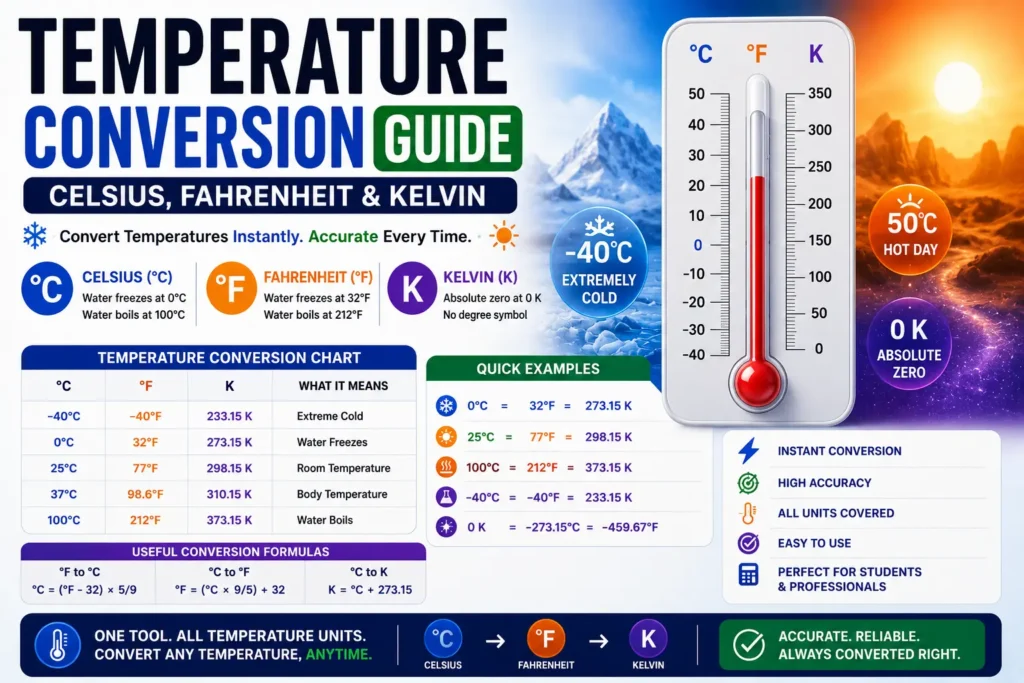
Temperature conversion is the everyday math behind oven settings, weather apps, lab notes, and travel packing lists. A recipe written in Celsius, a thermostat in Fahrenheit, or a science worksheet in Kelvin all describe the same thermal state — rewritten in another scale. This guide owns the formulas, charts, and worked examples for temperature conversion, then links the free ShoutingNow temperature converter.
Convert temperature now: Open the free Temperature Converter — Celsius, Fahrenheit, Kelvin, and more in one place. No sign-up required.
What temperature conversion is (and why scales differ)
Temperature measures how hot or cold something is. Converting temperature rewrites that reading on another scale without changing the physical heat. Celsius and Fahrenheit are offset scales (zero is not absolute zero); Kelvin and Rankine are absolute scales used in science and engineering. You convert when a weather forecast, appliance manual, or lab protocol uses a different scale than the one you think in.
Unlike length or mass, temperature conversion is not a simple multiply-by-factor for Celsius↔Fahrenheit — you must apply an offset. Absolute scales share the same degree size as their relatives (1 K = 1 °C; 1 °R = 1 °F) but start at absolute zero.
Plain-language temperature formulas
- Celsius → Fahrenheit: multiply °C by 9/5, then add 32. (°F = °C × 1.8 + 32)
- Fahrenheit → Celsius: subtract 32, then multiply by 5/9. (°C = (°F − 32) × 5/9)
- Celsius → Kelvin: add 273.15. (K = °C + 273.15)
- Kelvin → Celsius: subtract 273.15.
- Fahrenheit → Rankine: add 459.67. (°R = °F + 459.67)
For which everyday contexts prefer Celsius vs Fahrenheit — history and usage, not the conversion math — see Celsius vs Fahrenheit.
Temperature conversion tables
Celsius to Fahrenheit
| °C | °F |
|---|---|
| −18 | −0.4 |
| 0 | 32 |
| 10 | 50 |
| 20 | 68 |
| 37 | 98.6 |
| 100 | 212 |
| 180 | 356 |
Celsius to Kelvin (selected)
| °C | K |
|---|---|
| −273.15 | 0 |
| 0 | 273.15 |
| 25 | 298.15 |
| 100 | 373.15 |
Worked examples
Example 1 — oven from a metric recipe
A baking recipe says 190 °C. In Fahrenheit: 190 × 1.8 + 32 = 374 °F. Round to the nearest oven mark your dial allows (often 375 °F), not before converting.
Example 2 — fever check across scales
A clinic chart lists 100.4 °F. In Celsius: (100.4 − 32) × 5/9 ≈ 38.0 °C. Confirm the device’s scale before you compare to a home thermometer.
Example 3 — lab note in Kelvin
A protocol stores a sample at 277 K. In Celsius: 277 − 273.15 = 3.85 °C — roughly refrigerator-cold, not freezer-cold.
Common temperature conversion mistakes
- Forgetting the +32 / −32 offset on Celsius↔Fahrenheit and treating it like a pure ratio.
- Using 273 instead of 273.15 for precise Kelvin work (fine for rough estimates, not for lab write-ups).
- Confusing “room temperature” conventions (often ~20–25 °C / 68–77 °F) with a single fixed value.
- Mixing Rankine with Kelvin — both are absolute, but degree sizes differ (°R tracks Fahrenheit).
Temperature converter tools
Start with the multi-unit Temperature Converter for any from/to pair.
Related reading
- Celsius vs Fahrenheit — which scale people use and why (editorial; formulas stay here)
- Unit conversion chart & calculator guide — map of every category guide