
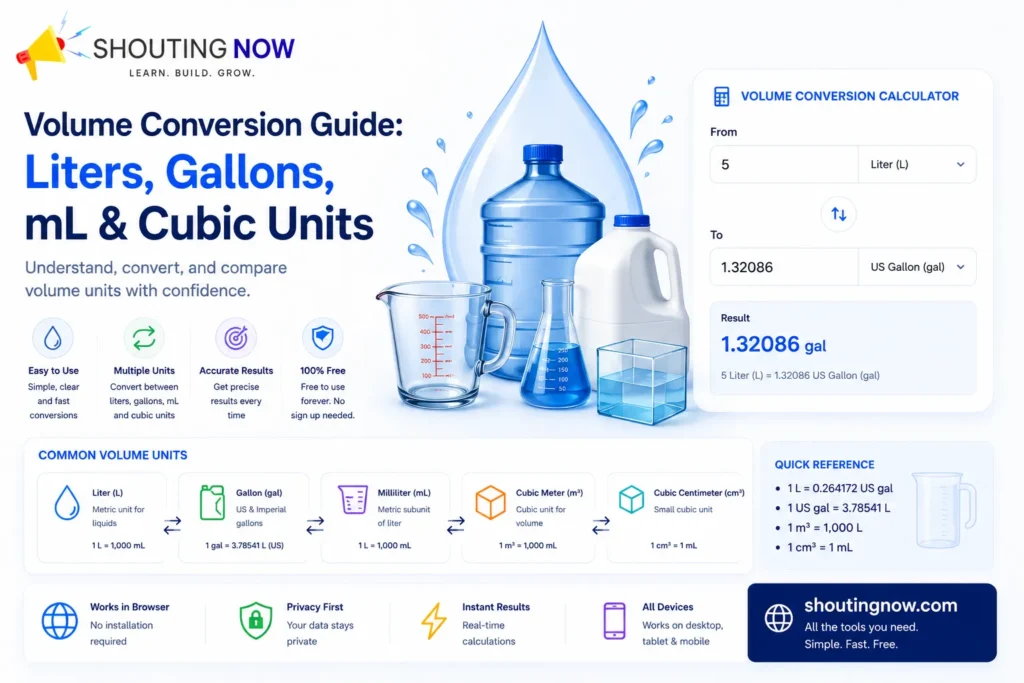
Volume conversion is what you reach for when a recipe lists milliliters, a fuel can is marked in liters, or a tank drawing mixes cubic feet with US gallons. Kitchen cups, lab flasks, and bulk storage rarely share one system — so liters to gallons (and the reverse) is the pair most people need first. This guide covers everyday volume conversion with plain formulas, tables, and realistic examples, then links ShoutingNow’s liquid and cubic tools.
Convert volume now: Open the free Liquid Volume Converter — liters, gallons, milliliters, cubic meters, fluid ounces, and more. Or use the dedicated liters to gallons converter for a single pair.
What volume conversion covers (and why it matters)
Volume measures how much space a liquid or solid occupies. Converting volume rewrites that capacity in another unit — milliliters to liters, US gallons to liters, cubic feet to gallons — without changing the physical amount. Cooks hit this on imported recipes; technicians hit it on tank labels; DIYers hit it when a bag of mulch is sold by the cubic yard and the bed was measured in cubic feet.
Two traps show up constantly: US vs imperial gallons, and fluid ounces vs weight ounces. Confirm which gallon system a datasheet uses, and never treat a kitchen fluid ounce as a scale ounce.
Plain-language volume formulas
- Liters ↔ US gallons: divide liters by 3.78541 for US gal (or multiply US gal by 3.78541 for liters).
- Liters ↔ imperial gallons: divide liters by 4.54609 for UK gal. An imperial gallon is larger than a US gallon.
- Milliliters ↔ liters: divide mL by 1,000. Multiply liters by 1,000 for mL.
- Cubic meters ↔ liters: 1 m³ = 1,000 liters exactly.
- Cubic feet ↔ US gallons: multiply ft³ by ≈ 7.48052 for US gal.
- US cups ↔ milliliters: 1 US cup ≈ 236.59 mL (useful for baking cross-checks).
For tank and room-scale work, convert to liters or cubic meters first, then to the display unit — that keeps intermediate rounding from stacking.
Volume conversion tables
Liters to US gallons
| liters | US gal (approx.) |
|---|---|
| 1 | 0.264 |
| 5 | 1.321 |
| 10 | 2.642 |
| 20 | 5.283 |
| 50 | 13.209 |
US cups and fluid ounces (kitchen)
| US measure | mL (approx.) |
|---|---|
| 1 fl oz | 29.57 |
| 1 cup | 236.59 |
| 1 pint | 473.18 |
| 1 quart | 946.35 |
| 1 gallon | 3,785.41 |
Worked examples
Example 1 — metric recipe on a US measuring cup
A batter calls for 375 mL of milk. In US cups: 375 ÷ 236.59 ≈ 1.58 cups (about 1 ½ cups plus 1 tbsp). Measuring “a cup and a half” alone undershoots the recipe.
Example 2 — aquarium fill from a liter label
A tank is rated 120 L. In US gallons: 120 ÷ 3.78541 ≈ 31.7 gal. Buy conditioner and heaters for ~32 gal capacity, not for a round “30 gallon” guess.
Example 3 — mulch bed in cubic feet
A bed needs 2.5 yd³ of mulch. In cubic feet: 2.5 × 27 = 67.5 ft³. If bags are sold by the cubic foot, order to that total rather than converting mid-purchase.
Common volume conversion mistakes
- Mixing US and imperial gallons. The same “gallon” number is not interchangeable across systems.
- Confusing fluid ounces with weight ounces. Fluid oz measure volume; oz on a food scale measure mass.
- Treating cups as exact across countries. A US cup (~236.6 mL) differs from a metric cup (250 mL).
- Rounding tank fills early. Convert once at full precision, then round for purchasing.
Volume converter tools
Start with the multi-unit Liquid Volume Converter, or jump to a dedicated pair (including volume-to-weight helpers when density is known):
- Liquid Volume Converter
- Liters to Gallons Converter
- Liters to Ounces Converter
- Gallons to Ounces Converter
- Cubic Feet to Gallons Converter
- Cubic Feet to Cubic Meters Converter
- Cubic Inches to Cubic Centimeters Converter
- Cubic Yards to Cubic Feet Converter
- Milliliters to Liters Converter
- Us Pints to (US) Fluid Ounces Converter
- Gallons to Pounds Converter
- Liters to Tons Converter
- Cubic Yards to Tons Converter
- Square Feet to Cubic Feet Converter
- Square Feet to Cubic Yards Converter
Related reading
- Unit conversion chart & calculator guide — map of every category guide on ShoutingNow