
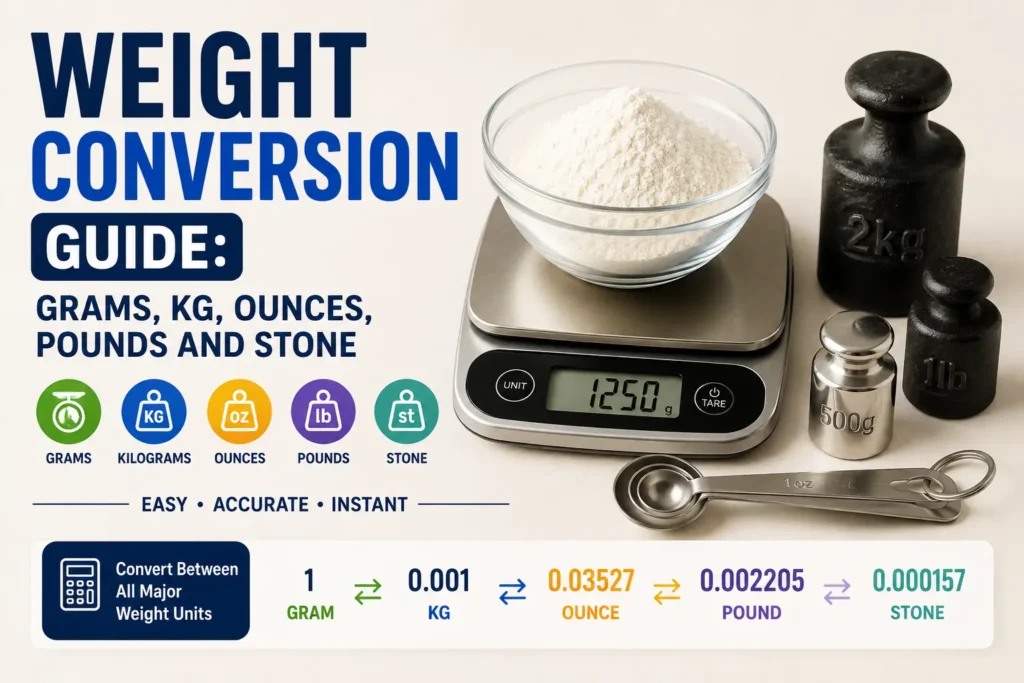
Weight conversion shows up when a recipe lists grams, a shipping label needs pounds, or a clinic chart expects kilograms. Kitchen scales, parcel carriers, and health apps rarely agree on one system — so pounds to kilograms (and the reverse) is the pair most people need first. This guide explains everyday weight conversion with plain formulas, charts, and realistic examples, then links ShoutingNow’s mass and weight tools.
Convert weight now: Open the free Mass & Weight Converter — switch between kilograms, pounds, ounces, grams, and more. Or use the dedicated kilos to pounds converter for a single pair.
What weight conversion covers (and when you need it)
In daily language, “weight” usually means how heavy something is on a scale. Physics separates mass (kilograms) from weight (force), but grocery labels, shipping forms, and bathroom scales all treat these converters as weight conversion tools. You convert when a flour bag is marked in grams, a carrier bills by pounds, or a health form asks for kg while your scale reads lb.
Small units matter too: milligrams and micrograms appear in supplements and lab notes. Those conversions are still linear — but a misplaced decimal is easy when you do them by hand.
Plain-language weight formulas
- Kilograms ↔ pounds: multiply kg by 2.20462 for lb. Divide lb by 2.20462 for kg.
- Pounds ↔ ounces: multiply lb by 16. Divide oz by 16 for lb.
- Grams ↔ pounds: divide g by 453.592 for lb (or multiply lb by 453.592 for g).
- Stone ↔ pounds: multiply stone by 14. UK body-weight readings often mix stone and pounds.
- Milligrams ↔ grams: divide mg by 1,000. Micrograms to milligrams: divide µg by 1,000.
A quick mental check for lb↔kg: half the kilogram value is a rough lower bound in pounds; multiplying by 2.2 is closer for everyday estimates — then verify with a converter when the number goes on a label or form.
Weight conversion tables
Kilograms to pounds
| kg | lb (approx.) |
|---|---|
| 0.5 | 1.10 |
| 2.27 | 5.00 |
| 5 | 11.02 |
| 70 | 154.32 |
| 113.4 | 250.00 |
Ounces to grams (kitchen)
| oz | g (approx.) |
|---|---|
| 1 | 28.35 |
| 4 | 113.4 |
| 8 | 226.8 |
| 12 | 340.2 |
| 16 (1 lb) | 453.6 |
Worked examples
Example 1 — baking from a metric recipe
A bread formula calls for 425 g of flour. In pounds: 425 ÷ 453.592 ≈ 0.937 lb, or about 15.0 oz. Weighing 15 oz on a US kitchen scale matches the recipe far better than “about a pound.”
Example 2 — parcel weight for a carrier
Your packed box reads 3.65 kg on a metric scale. Carriers often bill in pounds: 3.65 × 2.20462 ≈ 8.05 lb. Round up only if the carrier’s policy requires it — do not round before converting.
Example 3 — clinic form from a home scale
Your scale shows 168 lb. In kilograms: 168 ÷ 2.20462 ≈ 76.2 kg. Enter that on the form, then use the BMI Calculator if you also need height-based screening context.
Common weight conversion mistakes
- Confusing ounces (weight) with fluid ounces. Fluid oz measure volume; oz on a food scale measure mass.
- Using 2.2 as exact for shipping labels. 2.20462 is the standard factor; short estimates are fine for shopping, not for billed weight.
- Mixing stone+lb with pure pounds. “11 st 4 lb” is (11 × 14) + 4 = 158 lb — not 114 lb.
- Sliding the decimal on mg/µg. Each step is ×1,000 or ÷1,000; count the zeros carefully for supplements.
Weight and mass converter tools
Use the Mass & Weight Converter for any pair, or open a focused tool:
- Mass & Weight Converter
- Grams to Pounds Converter
- Kilos to Stone & lb Converter
- Kilos to Pounds Converter
- Micrograms to mg Converter
- Micrograms to Grams Converter
- Milligrams to Grams Converter
- Ounces to Pounds Converter
- Stone to Pounds Converter
Related reading
- Common unit conversion mistakes — cross-cluster traps in recipes, shipping, and forms
- BMI Calculator — convert weight, then check height-related screening ranges
- Unit conversion chart & calculator guide — full category map