
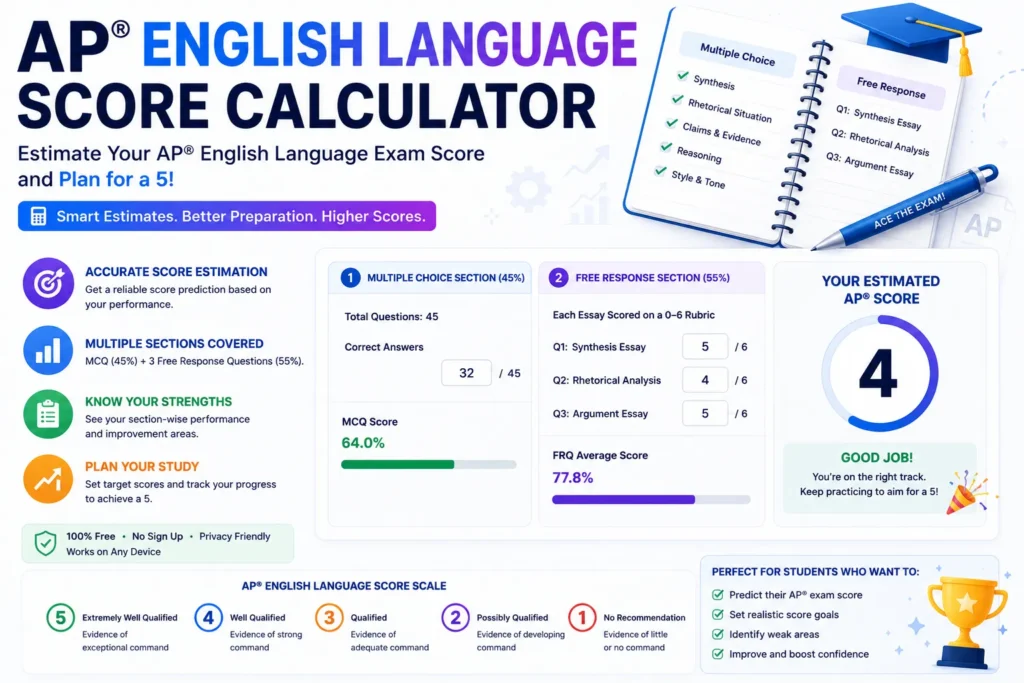
If you are preparing for the AP® English Language and Composition exam, you have probably finished a practice test and wondered: what AP score would this actually be? Raw points from multiple-choice questions and three essays do not map to a 1–5 score in your head — the College Board weights sections differently and adjusts cutoffs each year through equating.
This guide explains how AP® English Language scoring works, shows the math behind the weighted composite, and walks through realistic targets for scores 3, 4, and 5. Use our AP® English Language Score Calculator to plug in your practice results and read the predicted score on the gauge meter.
Estimate your score now: Open the free AP® English Language Score Calculator — enter MCQ correct answers and FRQ rubric points, pick a scoring curve year, and see your weighted composite on the gauge meter.
What is the AP® English Language exam?
AP® English Language and Composition tests rhetorical reading, analytical writing, and revision skills through nonfiction passages. The current format (2020 through 2026) has two sections:
- Section I — Multiple choice (45%) — 45 questions in 1 hour. Roughly half are reading comprehension and rhetorical analysis; the rest test writing revision and editing decisions.
- Section II — Free response (55%) — three essays in 2 hours 15 minutes (plus 15 minutes reading time): Synthesis (Q1), Rhetorical Analysis (Q2), and Argument (Q3).
Your final AP score of 1–5 is not a simple percentage. Section weights and year-specific curves matter — which is why a dedicated AP Lang score calculator helps more than guessing from raw points alone.
How each FRQ essay is scored
Since 2020, readers score each essay on an analytic 0–6 rubric:
| Dimension | Points | What it rewards |
|---|---|---|
| Thesis | 0–1 | A defensible, specific claim that responds to the prompt |
| Evidence and commentary | 0–4 | Specific evidence with analysis of how it supports the thesis |
| Sophistication | 0–1 | Nuance, complexity, or stylistic control that elevates the argument |
Most FRQ points live in evidence and commentary — not the thesis alone. When you use the score calculator, enter rubric points per essay (not a holistic 1–9 guess) for the most accurate weighted composite.
How the weighted composite score works
ShoutingNow applies the official section weights from College Board scoring guidelines:
- MCQ contribution = (correct answers ÷ 45) × 45 — effectively your raw MCQ count as the 45-point portion.
- FRQ contribution = (essay total ÷ 18) × 55 — essay total is Q1 + Q2 + Q3 (max 18).
- Weighted composite = MCQ contribution + FRQ contribution, out of 100.
Worked example
Suppose you answered 30 multiple-choice questions correctly and earned 5, 4, and 5 on the three essays (14 FRQ points total):
- MCQ contribution = 30
- FRQ contribution = (14 ÷ 18) × 55 ≈ 42.8
- Weighted composite ≈ 73/100 — typically a strong 4 on recent curves
Enter the same numbers in the calculator and click Calculate to see the gauge needle position and predicted AP score.
What AP score should you aim for?
| AP score | Designation | Typical college credit? | Approx. % of students (2024) |
|---|---|---|---|
| 5 | Extremely well qualified | Yes, at most schools | 9.8% |
| 4 | Well qualified | Yes, at most schools | 21.4% |
| 3 | Qualified | Yes, at many schools | 23.5% |
| 2 | Possibly qualified | Rarely | 28.8% |
| 1 | No recommendation | No | 16.6% |
A 3 is passing at many colleges. Scores of 4 and 5 open credit at most schools that accept AP — always verify your target institutions.
Approximate raw targets by AP score
| Target AP score | MCQ (out of 45) | FRQ total (out of 18) | Practice picture |
|---|---|---|---|
| 5 | 38–45 | 14–18 | Average 5–6 per essay; near-perfect MCQ |
| 4 | 30–37 | 11–14 | Average 4–5 per essay; strong MCQ |
| 3 | 22–29 | 8–11 | Average 3–4 per essay; adequate MCQ |
| 2 | 14–21 | 5–8 | Limited thesis or evidence development |
| 1 | 0–13 | 0–4 | Significant gaps in both sections |
These ranges are planning benchmarks. The College Board equates each exam year, so exact cutoffs shift — the calculator’s curve year toggle (2025, 2020, 2007, 2001) adjusts the 1–5 mapping.
Why FRQ practice matters more than most students think
Free response is 55% of your score. Improving each essay by one rubric point across all three adds roughly three weighted points — often more impactful than gaining five extra MCQ correct answers. The sophistication point (0 or 1 per essay) is especially high leverage at score boundaries.
When you debrief a practice test, ask:
- Did I earn the thesis point on each essay?
- Is my commentary specific, or generic device-listing?
- Did I leave the sophistication point on the table?
- Did I practice the writing-revision MCQ type, not only reading passages?
Model these scenarios in the AP® English Language Score Calculator before your next study block.
How to use the ShoutingNow score calculator
- Open the AP® English Language Score Calculator.
- Slide or step your MCQ correct count (0–45).
- Enter rubric points for Synthesis, Rhetorical Analysis, and Argument (0–6 each).
- Select a scoring curve year (start with 2025 if unsure).
- Click Calculate — results show MCQ/FRQ breakdown, weighted composite, and a gauge meter (like our BMI calculator) with the predicted 1–5 score.
Results appear only after you calculate — not while you are still adjusting sliders. Save a text summary with the Save button for your study notes.
Common scoring mistakes (and fixes)
Mistake 1: Treating MCQ and FRQ as equal
Problem: Spending 80% of study time on multiple choice when essays drive 55% of the score.
Fix: Balance timed FRQ practice with MCQ drills. Use the calculator to compare “+1 per essay” vs “+5 MCQ” for your current scores.
Mistake 2: Ignoring the analytic rubric
Problem: Guessing a holistic “4 essay” without thesis, evidence, and sophistication breakdown.
Fix: Score each essay against the official rubric rows before entering totals.
Mistake 3: Skipping writing-revision MCQs
Problem: Only practicing reading passages — leaving 20+ revision questions under-studied.
Fix: Add editing and style drills weekly; they are a distinct question type on Section I.
Mistake 4: Expecting exact official cutoffs
Problem: Treating any calculator as a guarantee.
Fix: Use estimates for goal-setting. Official AP scores come only from the College Board after equating.
Mistake 5: Not adjusting study time on test day
Problem: Spending exactly 40 minutes per essay regardless of difficulty.
Fix: If MCQ felt weak in practice tracking (~25 correct), plan for stronger FRQ performance — you can estimate needed essay averages with the calculator before Section II begins.
Test-day shortcut: “Three to Free”
A score of 3 is the minimum that “frees” you from many college English requirements. Everything above 3 widens where you earn credit. If you are tracking around 28+ MCQ correct during a practice run, you likely need essays averaging roughly 3–4 rubric points each to land near a 3 — verify with the calculator for your exact numbers.
Related tools for students
- EZ Grader Calculator — turn quiz wrong-counts into percentages for class grades
- Percentage Calculator — percent math for assignments and growth tracking
- This guide — scoring formulas and targets (bookmark for review season)
Frequently asked questions
The accordion below expands on common student questions. For live estimates, use the AP® English Language Score Calculator.
Exam prep & calculator resources on ShoutingNow
- AP® English Language Score Calculator — MCQ + FRQ inputs, scoring curves, and gauge meter
- AP® English Language Score Calculator Guide — this article with formulas and study targets
- EZ Grader Calculator — quick quiz percentages and weighted class grades
- Percentage Calculator — percent of a number, change, and difference
- Math & Calculators blog category — more student-focused guides
Disclaimer: AP® and Advanced Placement® are registered trademarks of the College Board, which was not involved in the production of, and does not endorse, this product.