
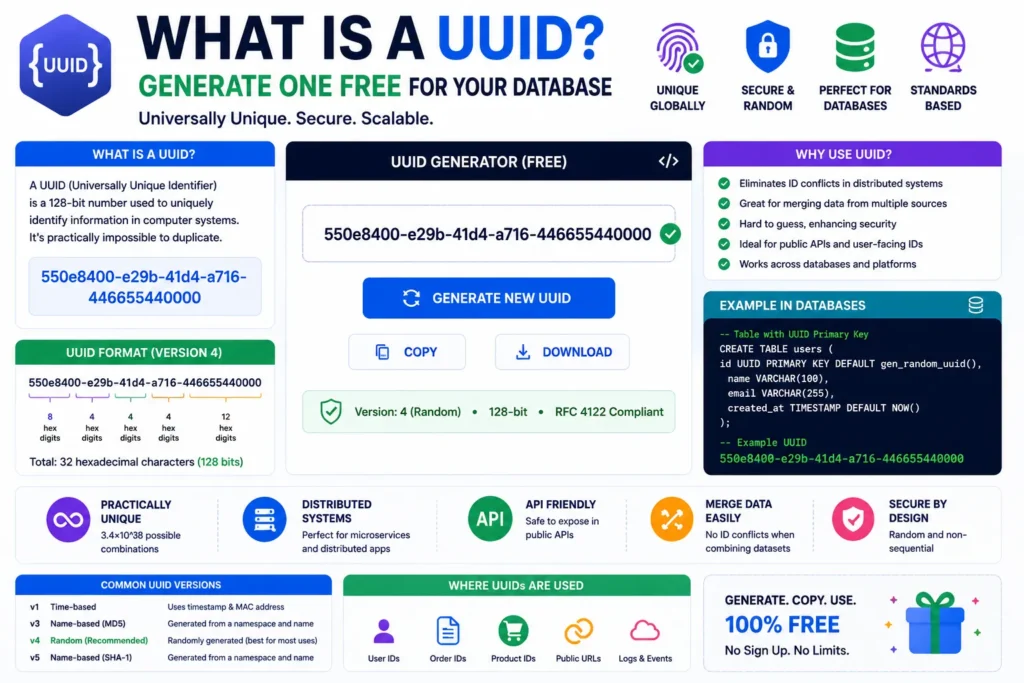
A UUID (Universally Unique Identifier) is a 128-bit label formatted as 36 characters — 32 hex digits plus four hyphens. Teams reach for UUIDs when auto-increment integers are too predictable, when databases must merge without ID clashes, or when an API needs opaque resource identifiers. This guide explains what UUIDs are, how each major version works, and when to pick one. When you need a value right now, open our free UUID Generator — Version 1, 4, 7, nil, and GUID formats, bulk up to 500, copy or download, all in your browser.
Generate a UUID now: Open the UUID Generator — RFC 4122 v1/v4, RFC 9562 v7, nil UUID, and braced GUID. No signup, no server round-trip.
What is a UUID?
Think of a UUID as a very large random (or time-stamped) number written in hexadecimal. The standard layout is:
550e8400-e29b-41d4-a716-446655440000
|  time/random  | ver | var |      node / random       |
That string holds 128 bits — enough combinations that accidental collision is negligible for practical systems, provided you use a proper generator and enforce uniqueness in your schema.
UUIDs appear under several names: GUID (Globally Unique Identifier) in Microsoft ecosystems, uuid in PostgreSQL, and uniqueidentifier in SQL Server. The bit pattern is the same; only formatting conventions differ.
How UUID generation works (by version)
Version 4 — random (recommended default)
Version 4 sets 122 random bits and fixes 6 bits for version (4) and variant (10 binary prefix). Browsers expose this via crypto.randomUUID() or crypto.getRandomValues(). Use v4 for primary keys, session IDs, and public API resources when you do not need sort order.
Version 7 — time-ordered (modern alternative to v1)
Version 7 (RFC 9562) places a 48-bit Unix timestamp in milliseconds in the leading bits, then fills the rest with random data. Indexes on v7 columns stay roughly sequential like auto-increment, but IDs remain opaque and do not embed MAC addresses.
Version 1 — timestamp + node
Version 1 encodes a 60-bit timestamp (100-ns intervals since 15 October 1582) plus a clock sequence and 48-bit node field. Historically the node was a MAC address; modern generators randomize it. Prefer v7 unless a legacy dependency requires v1.
Nil UUID
The nil UUID is the constant 00000000-0000-0000-0000-000000000000. Schemas use it to mean “no identifier set.” Do not insert it as a real primary key.
GUID format
A GUID wraps the same value in curly braces with uppercase hex: {550E8400-E29B-41D4-A716-446655440000}. Our GUID tab produces this format from a Version 4 UUID.
UUID format and formulas
Standard string form:
UUID = time_low "-" time_mid "-" time_hi_and_version "-"
       clock_seq_and_variant "-" node
For Version 4, random bytes R[0..15] are adjusted:
R[6]  = (R[6]  & 0x0F) | 0x40   // version 4
R[8]  = (R[8]  & 0x3F) | 0x80   // RFC variant
Collision risk for v4 is dominated by the birthday paradox: with n generated IDs, approximate collision probability scales with n² / 2^122 — astronomically small at any realistic n.
Step-by-step: generate and use a UUID
- Open the UUID Generator and choose a version tab (Version 4 for most cases).
- Click Generate and copy the result, or enter a bulk count (max 500) and export via Copy all or Download.
- Store the value in your database column typed as
UUID,CHAR(36), or native binary (16 bytes) depending on your engine. - Add a UNIQUE constraint — never rely on probability alone.
- For public URLs, prefer v4 or v7 over sequential integers to avoid enumeration.
Example in databases
CREATE TABLE orders (
  id         UUID PRIMARY KEY DEFAULT gen_random_uuid(),
  user_id    UUID NOT NULL,
  total_cents INTEGER NOT NULL,
  created_at TIMESTAMPTZ NOT NULL DEFAULT now()
);
PostgreSQL's gen_random_uuid() produces Version 4 values server-side. Client-generated UUIDs from our tool are equally valid when inserted explicitly.
Use cases
| Scenario | Why UUIDs fit | Suggested version |
|---|---|---|
| Microservice order IDs | Each service mints IDs without a shared counter | v4 or v7 |
| Public download links | Non-guessable tokens in URLs | v4 |
| Time-series tables with B-tree indexes | Inserts stay sequential in the index | v7 |
| Offline-first mobile apps | Create records before sync | v4 |
| Log trace IDs | Correlate spans across hosts | v4 |
| .NET / Windows registry | Tools expect braced GUID strings | GUID tab |
| Nullable foreign key placeholder | Sentinel “empty” value in APIs | Nil UUID (constant) |
Common mistakes and solutions
| Mistake | Problem | Solution |
|---|---|---|
| Using v1 for privacy-sensitive public IDs | Old v1 implementations exposed MAC-derived node bits | Use v4 or v7; ensure node field is randomized |
| Storing UUID as string without index plan | 36-char strings bloat indexes vs 16-byte binary | Use native UUID type or BINARY(16) where supported |
| Assuming uniqueness without a DB constraint | Birthday paradox + bugs can collide | Always declare PRIMARY KEY or UNIQUE on the column |
| Using nil UUID as a real key | Every “empty” row shares one ID | Use NULL for absent keys; reserve nil for explicit sentinel semantics |
| Mixing uppercase GUID and lowercase uuid in joins | String comparisons fail across formats | Normalize to one casing in application code |
| Choosing v4 when index locality matters | Random inserts fragment B-tree pages | Switch to v7 for time-ordered clustering |
| Regenerating v3/v5 name-based IDs incorrectly | Same name must always yield same UUID | Implement RFC name hashing in code — not random generation |
UUID vs auto-increment integers
| Factor | UUID | Auto-increment |
|---|---|---|
| Uniqueness across shards | Strong — no coordinator | Requires central sequence or offset ranges |
| URL guessability | Low (v4/v7) | High — sequential exposure |
| Storage size | 16 bytes (binary) or 36 chars | 4–8 bytes typical |
| Index locality | v4 random; v7 good | Excellent |
| Human readability | Poor | Better for small counts |
Privacy and security notes
UUIDs from our generator are created locally with your browser's CSPRNG. ShoutingNow does not log or store them. Version 4 and v7 values reveal no user data by themselves, but predictable v1 timestamps can hint at creation order. Treat UUIDs in URLs as capability tokens — anyone with the string may access the resource if authorization is missing.
Generate your next UUID
Use the ShoutingNow UUID Generator for instant Version 1, 4, 7, nil, and GUID output — bulk export included. Bookmark this UUID guide for version comparisons, schema examples, and troubleshooting, then share the tool with your team for unlimited free use.